
Overview
Around the turn of the twentieth century, several styles and genres of music came together, and the city of New Orleans provided the catalyst for the formation of jazz. The earliest style of jazz, and one that remained popular for decades after its inception, was called Dixieland. Dixieland, like other types of jazz, allows us the chance to look at many issues of musical, racial, and commercial issues in the first quarter of the twentieth century.
Objectives
- Examine the predecessors of jazz and the diversity of styles and genres that combine in order to create the earliest jazz
- Identify the instruments, musical form, and performance style of Dixieland jazz
- Examine how the issues of race affected the earliest commercial distributions of jazz
- Identify the key figures and songs in Dixieland jazz
New Orleans: The Birthplace of Jazz
New Orleans had a rich mix of cultures, religions, races, and ethnic communities—Spanish, French, African, English, Irish, German, Cajun, West Indian, Catholic, Protestant, Creole, Native American, to name a small fraction. This rich cultural mix inspired a plurality of musical styles.
In the outdoor society of New Orleans, every organization had its own marching band to play for events and get-togethers. These bands provided the soundtrack for social life in New Orleans. New Orleans also was a manufacturing center for wind instruments, and as a port of embarkation for Spanish-American troops, it was loaded with cornets, clarinets, trombones, and drums in the pawn shops and second-hand stores. Bands were the entertainment on the river boats, and bands helped advertise prize fights, department store bargain sales, and ball games. The band might consist of anywhere from five to ten members, with guest musicians often invited to help out.
At one time in the nineteenth century, there were three opera companies in New Orleans. The big churches all had rich choral music traditions. A Negro Philharmonic Society of one hundred members presented concerts and recitals and brought in guest artists on a regular basis.
Trained music teachers were abundant. The annual Mardi Gras celebration was, and still is, non-stop music.
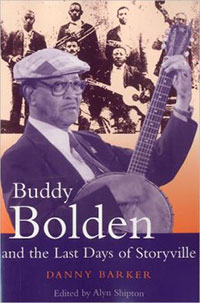
Prostitution was legal in New Orleans, which meant that the nightlife also needed music. In 1897, Sidney Story, a New Orleans alderman, persuaded the city fathers to legalize prostitution within a sixty-four square block area specifically bordered on the north by Robertson and on the south by Basin Street. To his dismay, the area came to be known as Storyvillean area in New Orleans where prostitution was legal until 1917; many early jazz musicians got their starts playing in brothels here and it flourished until 1917 when the U. S. Navy declared it illegal to operate a house of prostitution within five miles of a military institution. Most of the brothels had piano players who entertained the guests with ragtime selections, popular Tin Pan Alley tunes, and the blues. Sometimes, in more up-scale establishments, there would be a small band with three or four members. A number of early jazz musicians such as Buddy Bolden and Jelly Roll Morton got their starts by playing music in brothels.
The New Orleans funeral tradition also plays a critical role in the development of jazz. On the way to the cemetery, the band would play selections of hymns in a solemn and sacred performance style. After the burial, on the way home from the cemetery, the band would play the same hymns, but now uptempo and often syncopated. They incorporated ragtime musical gestures, such as the steady bass notes, wide leaps in the bass line, and a syncopated melody, into their renditions of hymns. The funeral-goers were no longer mourning but were instead celebrating that their dearly departed had been released from all worldly sorrows. If some of the funeral band members were on a flat-bed wagon, the trombone player would be put on the back of the wagon, pointing his instrument away from the band members and away from the people walking alongside the wagon, so that his trombone slide would not bump anyone or get damaged. The term tailgate trombonestyle of Dixieland jazz playing that includes many trombone smears; it earned its name from the fact that a trombone player would sit in the back of the wagon with the tailgate down refers to the large movements a trombone player might make when sliding from one note into the next.



