
Overview
The music of contemporary Mexican American culture ranges in style from traditional Mexican styles such as norteño and mariachi, to hybrid forms that combine the polka/ranchera sound with country, rock and roll, and cumbia, to hip hop and rap styles. Often the term Tejano is used generally to indicate any of these styles that have developed in Texas. However, for our purposes, the term Tejano will be used more specifically to indicate a modern, expanded conjunto style (electrified bajo sexto, bass, accordion, drumset, synthesizer and additional instruments). Individual artists and bands from California, Arizona, and Texas have driven the innovation of new approaches to traditional music with a resultant diversity of material. The selected artists and genres in this chapter will include Little Joe y la Familia, Jimmy Gonzalez y Mazz, David Lee Garza y los Musicales, Patsy Torres, Linda Ronstadt, Los Lobos, and Selena.
Objectives
- Identify the instrumental ensembles and musical styles of La Onda Chicana, Mariachi, Tejano, Rock and Tejano/Cumbia aurally
- Recall the contributions and innovations of selected artists to Mexican American popular music
- Identify the following song/dance forms: polka, cumbia, son jarocho, son jalisciense
- Examine the cultural context that these ensembles, genres and forms originate from and understand them as part of an ongoing, bi-cultural musical expression
Traje de Charro
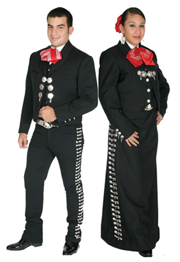
By 1908 groups were dressing in the traje de charrostandard performance “suit” worn by mariachis descended from the wealthy Mexican rancher’s dress(wealthy rancher's suit) instead of the folk attire of white pants/shirt with a red tie and hat. The traje is visually stunning and properly accentuates the exuberant, vigorous nature of the music.
The standard mariachi ensemble of today (that evolved over the decades), includes up to 6 violins, the armoniathe “rhythm section” of the mariachi, played by the vihuela, guittaron and guitar (harmony/rhythm) section consisting of guitarron, vihuelasmall, 5 stringed, guitar with a rounded spine used in mariachi music, guitar, and 2 trumpets. Additional instruments may include harp, wind instruments, and keyboard.
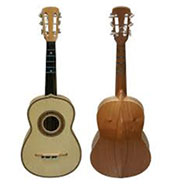
The two mariachi instruments indigenous to Mexico are the vihuela, and guittaron large, bass guitar with a rounded spine used in mariachi music, both descendants of Spanish instruments brought by the conquistadoressoldiers, explorers, and adventurers at the service of the Portuguese and Spanish Empire beginning in the early 1500s. Both feature a rounded spine, presumably developed to produce more volume in acoustic, outdoor performances. The guittaron is a large, bass guitar while the vihuela is a much smaller guitar that plays complicated rhythmic strums. The two work in tandem to produce the characteristic dance rhythms of the music.

"[Little Joe Hernandez] has been described as a "Latino Elvis.""


