
Overview
The music of contemporary Mexican American culture ranges in style from traditional Mexican styles such as norteño and mariachi, to hybrid forms that combine the polka/ranchera sound with country, rock and roll, and cumbia, to hip hop and rap styles. Often the term Tejano is used generally to indicate any of these styles that have developed in Texas. However, for our purposes, the term Tejano will be used more specifically to indicate a modern, expanded conjunto style (electrified bajo sexto, bass, accordion, drumset, synthesizer and additional instruments). Individual artists and bands from California, Arizona, and Texas have driven the innovation of new approaches to traditional music with a resultant diversity of material. The selected artists and genres in this chapter will include Little Joe y la Familia, Jimmy Gonzalez y Mazz, David Lee Garza y los Musicales, Patsy Torres, Linda Ronstadt, Los Lobos, and Selena.
Objectives
- Identify the instrumental ensembles and musical styles of La Onda Chicana, Mariachi, Tejano, Rock and Tejano/Cumbia aurally
- Recall the contributions and innovations of selected artists to Mexican American popular music
- Identify the following song/dance forms: polka, cumbia, son jarocho, son jalisciense
- Examine the cultural context that these ensembles, genres and forms originate from and understand them as part of an ongoing, bi-cultural musical expression
Selena
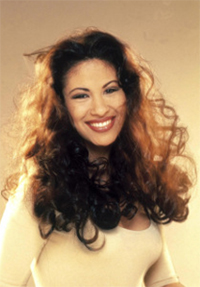
Selena Quintanilla, born in Lake Jackson, Texas, officially started her career at the age of 12 when her first album, Selena y los Dinos was released. It featured her as a vocalist with her siblings, A.B (bass) and Suzette (drums). Her father, Abraham, had wanted to be a professional musician in his youth but had to turn to other occupations to support his family. He managed the family band which eventually became their livelihood. Selena's expressive and powerful voice, her creative costume designs, dance moves, and her rendition of songs written by her brother, quickly propelled her to fame. Three successive albums went platinum, (Entre a mi Mundo, Selena Live!, Amor Prohibido). Selena Live! won a Grammy in 1993. According to TIME magazine, Selena "was the embodiment of young, smart, hip Mexican-American youth wearing midriff-baring bustiers and boasting a tight-knit family and a down-to-earth personality, a Madonna without the controversy."
As Selena rose to fame, she did not abandon her Texas fan-base but remained a role model promoting education for Hispanic youth, particularly young women. Selena's importance as a symbol of her Tejano roots and of her concern for her people was shown by the homage they paid her after her death.
On March 31, 1995, 23 year old Selena Quintanilla was killed by an employee who was embezzling funds from her fan club. She was in the midst of moving into the English pop market and had already recorded songs for the cross-over album Dreaming of You which was released posthumously. The album debuted at number one on the U.S. Billboard 200 making her the first Hispanic singer to accomplish this feat and went on to sell two million copies in its first year.
In the wake of the tragedy, a media blitz prompted unauthorized Selena books, recordings, and video specials. In 1997, a Selena movie and soundtrack was produced featuring Jennifer Lopez, and a broadway-style musical toured. All of this activity helped to keep Tejano music in the limelight for a year or two after Selena's death, but gradually the momentum faded and Tejano, on the brink of international recognition, returned to its regional base.
From the early to mid-1990s, Tejano groups started touring in Mexico with success, began to be played regularly on the radio and recognized by the music awards. To accommodate huge numbers of fans, music festivals had moved to arenas and artists like Selena and Emilio were moving to new markets and mainstream styles. Peaking in 1995, the rapid growth phase of the Tejano industry was over and shortly after, the music started to lose its original vibrancy and message, replaced with mass-marketing and over-production.
Listening Examples



