
Overview
In the 1920s, a new type of jazz emerged that was related to, but separate from, Dixieland. Called swing or big band, this music often had less improvisation, more dancing, and more instruments than its Dixieland counterpart. Led by bandleaders such as Duke Ellington, Benny Goodman, and Fletcher Henderson, swing bands provided the soundtrack for dancing and merrymaking during what were becoming increasingly difficult times in the United States.
Objectives
- Recognize the difference between swing music and Dixieland jazz such as instrumentation, form, purpose, and composition
- Examine how race relations affected the performance and recording of swing music throughout the 1930s and 1940s
- Identify various bandleaders and the way each cultivated a specific style within their individual groups such as Count Basie’s Kansas City swing style
White Swing Bandleaders
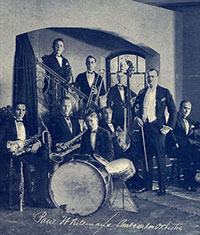
Although Fletcher Henderson and Duke Ellington were both successful African American bandleaders, the first major star leader of a swing band was Paul Whiteman. Known as the "King of Jazz," he said, "I want to make a lady out of jazz." His approach was always symphonic in scope and intent. He played mostly in concerts and theaters and very little in dance halls and nightclubs. His groups were large, but he interlaced the sections with outstanding jazzmen such as Jimmy and Tommy Dorsey, Frankie Trumbauer, and Jack and Charlie Teagarden. He appeared with his huge orchestra in many movies. Most of the famous big band musicians of the 1930s and 1940s were touched directly or indirectly by Whiteman. A man of great respect for the jazz talent he gathered in his orchestra, Paul Whiteman earned a listing among the important and influential big band leaders of the time.
The Jewish clarinetist and bandleader Benny Goodman became the symbol of swing music in the mid-1930s. In 1934, Goodman formed a band to audition for a radio network broadcast called Let’s Dance. The National Biscuit Company sponsored the radio show, and it ran on NBC on Saturday nights. Goodman’s band was soon a favorite among listening audiences. In 1935, the Benny Goodman Band was selected by the authoritative jazz journal Metronome as the "Best Swing Band of 1935." Soon, newspapers began to refer to Goodman as the "King of Swing."
With his reputation growing, Goodman went on tour in 1935. At the Palomar Ballroom in Los Angeles, Goodman introduced "Sing, Sing, Sing ♫." "Sing, Sing, Sing ♫" was originally written and recorded by Louis Prima, but Goodman and his band made the song a smash hit in its instrumental version. The infections melodies, driving rhythm, and brassy fanfares electrified audiences. The response startled the band because many of the kids stopped dancing, and pressed toward the front of the stage in order to see and hear the band and its exciting new sounds.
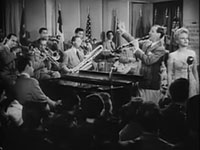
White bandleaders had decidedly greater financial success than their black counterparts. Between 1935 and 1945, the Benny Goodman band, the Jimmy Dorsey Orchestra, the Glenn Miller Orchestra, and the Tommy Dorsey Orchestra had a total of 292 records that were in the top ten. In contrast, the orchestras of African American bandleaders Duke Ellington, Count Basie, Jimmy Lunceford, and Chick Webb only had 32 records in the top ten.



