
Overview
First called “hillbilly music” by record labels, early country and western music was recorded in southern areas of the United States by ambitious record producers who were looking for a new, commercially-appealing sound. With the advent of radio, this type of music became incredibly popular, spawning a number of subgenres, such as bluegrass, honky-tonk, and country crooning. The film popularity of singers such as Gene Autry also cemented the image of the singing cowboy in the minds of many Americans. As we will see, early country and western music had many themes and images that continue to permeate country music to this day.
Objectives
- Examine how country music was first discovered by record executives such as Ralph Peer and what made it so commercially appealing
- Identify early recording artists who increased the commercial appeal of hillbilly music
- Recognize the several subgenres of country music developed during and after World War II
- Identify instruments played in a bluegrass ensemble
- Recall the BMI and the ASCAP strike in the early 1940s and how it helped the development and distribution of early country music
The Earliest Country Music continued
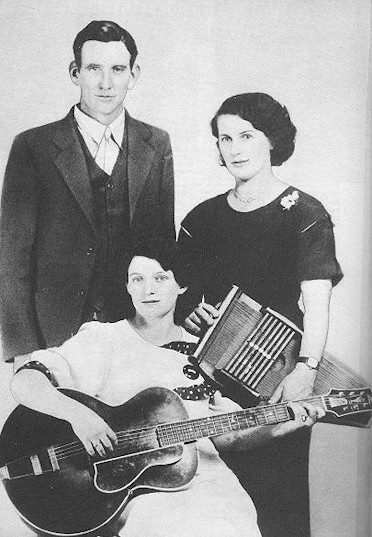
The Carter Family was one of the most commercially successful of these early country music groups. A.P. Carter married Sara Dougherty in 1915, and their home in Maces Spring, Virginia soon became a neighborhood hangout for local music fans and performers. When Maybelle Addington married E. J. Carter (A.P.’s brother) in 1926, she brought into the family her superb skills on autoharp, banjo, and guitar. Over the years, the Carters recorded some three hundred compositions on a dozen or more labels, becoming one of the most influential acts in the history of early country music.
Sara sang soprano, Maybelle sang alto, and A.P. sang bass or baritone, depending on the song. That disposition of harmony parts is still common in Southern Gospel trios today. Maybelle Carter revolutionized the use of the guitar by developing a technique called the Carter scratcha guitar technique developed by Maybelle Carter in which she used her thumb to play the melody on the guitar’s bass strings, and then she supported the melody by strumming her fingers over the other strings, in which she used her thumb to play the melody on the guitar’s bass strings, and then she supported the melody by strumming her fingers over the other strings. She was one of the first guitarists to use the guitar as a melodic instrument rather than just as harmonic support in the rhythm section. This technique can be heard in the introduction of "My Honey Lou" and "Keep on the Sunny Side ♫." Maybelle Carter’s guitar style and some of her specific licks (short melodic motives) can be heard in almost any modern guitarist’s version of "Wildwood Flower," one of the Carter Family’s special numbers.
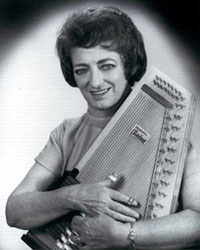
For over half a century, guitarists have acknowledged Maybelle Carter as a major influence on their guitar playing.A.P. Carter also wrote a good number of tunes for the group, and after they moved from Victor to Columbia and Decca, he secured copyrights on both his own works and the public domain traditional songs—many of which were deep fundamentalist Christian songs. "Can the Circle Be Unbroken? ♫" is an adaptation of the hymn "Will the Circle Be Unbroken?" which was a popular song with many Protestant congregations. The remainder of the Carter’s recordings consisted of secular songs on topics of intense grief and despair, a trope which remains common in country music to this day.
In later years, Maybelle Carter’s three daughters Helen, June, and Anita joined the Carter Family, and even after the elder Carters divorced, the group held together. After a while, Maybelle and her three daughters continued on by themselves until Maybelle’s death. June Carter eventually married Johnny Cash, and the family music tradition continues among the many Carter relatives in Virginia during the twenty-first century.
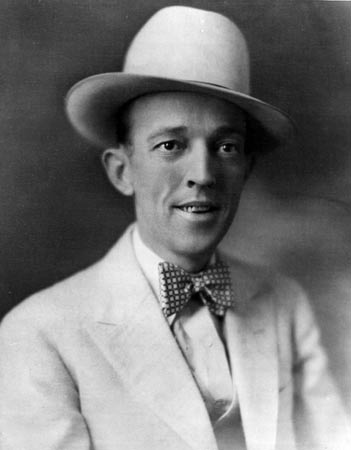
The second artist that Ralph Peer "found" during his Bristol, Tennessee recording sessions in 1927 was Jimmie Rodgers. Jimmie Rodgers’ style drew on his early experience with and exposure to African American blues and work songs. Rodgers had a sad life in many ways. His mother died when he was four, and he was discovered to have tuberculosis in late adolescence.
With no formal schooling, Rodgers followed his father around the railroad gangs from one job to another. It was here that he learned 12-bar blues and work songs from the African American railroad workers and learned to play banjo and guitar. He worked as a railroad brakeman, city detective, vaudeville performer, and blackface musician until he made his first recording for Peer. In his first recording session, he sang his versions of two traditional songs, accompanying himself on the acoustic guitar. On the second, "Sleep, Baby, Sleep ♫," he yodeled. Although hillbilly musicians had been yodeling for decades, Rodgers was the first artist to make the gesture famous. During his sessions with Victor, he recorded twelve blue yodels. The first of these is known as "T for Texas ♫," although Victor listed it as "Blue Yodel" when it was released.
Rodgers was one of the first country music stars, recording for Victor, traveling in vaudeville shows, playing the occasional radio show, and traveling on modest tours. His poor health prevented him from traveling too extensively, which negatively affected how much he was able to promote himself. He died in New York in 1933 after completing his final recording session.



