
Overview
As we saw in earlier lessons, solo singers became increasingly important during the 1930s. Singers such as Ella Fitzgerald and Bing Crosby built long, successful careers with their interpretations of jazz and Broadway standards. More and more singers followed in this mold in the 1940s and early 1950s, including Frank Sinatra, Perry Como, Patti Page, and Doris Day. Singing groups were common as well, such as the Ink Spots and the Boswell Sisters. Although many singers began in the Broadway or big band mold, many branched out into covers of all types of tunes from a variety of genres.
Objectives
- Examine a number of popular singers and singing groups from the 1940s and 1950s
- Examine how each singer or group offered a unique perspective for the interpretation of standard tunes
- Recognize the different interpretations of the same standard
- Examine how each artist was able to create an identity while performing much of the same repertory
Introduction
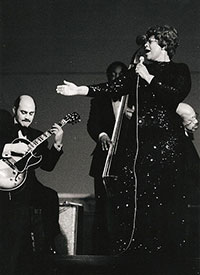
Traditional pop songs took shape during the 1920s when composers of stage musicals began overtaking the Tin Pan Alley songwriters in popularity. Pop songs were different from the songs found in vaudeville, jazz, gospel, blues, and other genres. They were typically genteel in their language, and they were never crass or over-the-top. In addition, the songs have memorable melodies and harmonies that lend themselves to imaginative instrumental treatment and interpretations. The tunes were raw material which musicians arranged and re-arranged for singers, dance bands, movie scenes, and nightclub shows.
At the same time, jazz groups, dance bands, radio shows, recording artists, and film musicals created a voracious appetite for these new, more artistic pop songs.
Under these circumstances, a popular tune such as Hoagy Carmichael’s "Stardust ♫," for example, would earn millions of dollars for its composer and performers in live performance, radio, movie, and recording royalties. One good traditional pop tune was a valuable piece of copyright merchandise.
Solo singers became increasingly important during the 1930s. Many big bands, such as those of Duke Ellington, Count Basie, and Benny Goodman, also included a singer. The singers earned less than the other members of the band, and they usually performed much less frequently. However, audiences loved the singers, and with time, the singers became the star attractions. Singers such as Ella Fitzgerald and Bing Crosby built long, successful careers with their interpretations of jazz and Broadway standards. More and more singers followed in this mold in the 1940s and early 1950s. Although many singers began in the Broadway or big band mold, many branched out into covers of all types of tunes from a variety of genres.
What follows is a survey of traditional pop singers who were stars during the 1940s and 1950s. It is important to note that all of these musicians were singers, not songwriters or composers. It was very unusual for a singer to write his or her own material. Instead, most singers performed their own interpretations of what had become standard repertory, such as songs by the Gershwins, Cole Porter, and Rodgers and Hammerstein. As we will see, some singers had careers that began early than 1940, and others were lucky enough to have careers that lasted well beyond the 1950s. These singers and their interpretations of popular songs represent the mainstream popular music of the World War II era.



