
Overview
As we saw in earlier lessons, solo singers became increasingly important during the 1930s. Singers such as Ella Fitzgerald and Bing Crosby built long, successful careers with their interpretations of jazz and Broadway standards. More and more singers followed in this mold in the 1940s and early 1950s, including Frank Sinatra, Perry Como, Patti Page, and Doris Day. Singing groups were common as well, such as the Ink Spots and the Boswell Sisters. Although many singers began in the Broadway or big band mold, many branched out into covers of all types of tunes from a variety of genres.
Objectives
- Examine a number of popular singers and singing groups from the 1940s and 1950s
- Examine how each singer or group offered a unique perspective for the interpretation of standard tunes
- Recognize the different interpretations of the same standard
- Examine how each artist was able to create an identity while performing much of the same repertory
Louis Armstrong
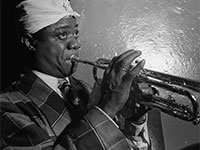
Surely one of the most beloved pop singers of the twentieth century was Louis Armstrong. Although we discussed him earlier in the context of Dixieland jazz, Armstrong was equally respected and admired as both a jazz musician and as a singer. His career lasted fifty years, and his raspy voice endeared him to audiences. Early in his career, he recorded instrumental music with his ensembles, such as the Hot Five and the Hot Seven.By the 1930s, however, Armstrong frequently teamed up with big band leaders such as Count Basie to sing pop standards.
As we saw in an earlier lesson, Armstrong was also the first of the jazz "scat" singers, singing improvised phrases on neutral syllables. His duets with Ella Fitzgerald, such as "They Can't Take That Away From Me ♫" and "Dream a Little Dream of Me ♫" are particularly charming. In songs such as "It Don’t Mean a Thing (If It Ain’t Got That Swing) ♫" and "Ain't Misbehavin' ♫" Armstrong would both play his trumpet and sing.



