
Overview
Objectives
- Examine the commercial aspects that led to many changes in rock and roll music of the early 1960s
- Examine the different interests of major record labels, television stations, and disc jockeys and the conflicts between different parties which brought unprecedented changes in the music of the era
- Discuss the role of songwriters in the creation of popular music of the time
American Bandstand
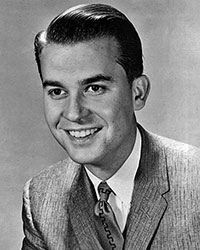
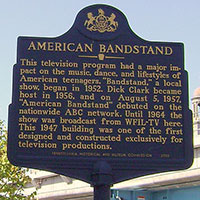
After several modest jobs in radio and television, Dick Clark got his big break. He took over Bob Horn's Bandstand, changed the name to American Bandstand, and did his first big program on August 5, 1957. The show aired for 90 minutes each weekday afternoon and on Monday nights from 7:30 to 8:00 p.m. These were ideal times for a teenage viewing audience that could be counted on to turn the program on as soon as they got home from school each afternoon. On the program, one hundred fifty teenagers were in the audience, many of them getting up to dance and to offer their opinions about the music. With his smooth patter and impeccable good taste, Clark would mingle with the members of the teenage audience, and he would then interview several guest musical artists before they got up to lip-sync their most recent hits.
The performers lip-synced instead of performing live in order to prevent any unpredictable behavior or spontaneity during the performance. There would be no shenanigans like Elvis’s electrified hips on The Milton Berle Show or Jerry Lee Lewis throwing his piano bench on The Steve Allen Show. For many of the performers on the show, lip-syncing was also preferable to a live performance because the majority of these performers were not strong singers. Instead, they were chosen for their good looks and wholesome appeal and then turned into pop stars by major record labels. This point will be elaborated later in this lesson.
Clark’s business savvy transformed a local telecast into a national phenomenon. To get sponsors for the show, he traveled the advertising agency circuit on Madison Avenue and eventually acquired the lucrative Beechnut Spearmint Gum account. In no time at all, Clark became famous and very wealthy. He was one of the most influential disc jockeys in the nation. Clark was never accused of taking payola, but his business connections were scrutinized. He had controlling interest in six publishing companies, held over 160 copyrights, and owned four record labels (Swan, Chancellor, Cameo-Parkway, and Jamie Records). He also owned a record pressing plant, the Chip Record Distribution Corporation, an artist management firm, the touring Dick Clark’s Caravan of Stars, and a concert format of the live broadcast that was called The Dick Clark Show—33 corporations, in all. Clark was a shrewd businessman. For example, he had no financial interest in the Luther Dixon’s song "Sixteen Candles ♫" as recorded by The Crests, and he therefore played the song only four times in ten weeks on American Bandstand. After he purchased the company that published "Sixteen Candles ♫," though, he played it 27 times in thirteen weeks. Shortly before the payola hearings, he divested himself of 31 of his 33 companies, and then he re-purchased those same companies later when the hearings were done.
For nearly ten years, American Bandstand a television show hosted by Dick Clark that featured lip-synced performances by the latest teen stars was a primary force in the creation of a whole outlook on teenage life— hairstyles, clothes fashions, dating issues, and all the other adolescent concerns about behavior and social values. More important than any other aspect of teenage culture, though, was American Bandstand’s emphasis on dancing. The rock and roll music of the 1950s was focused on the performer and the performance rather than dancing to the music that was being performed. American Bandstand changed that outlook, putting primary importance on being able to dance along with a song. Chubby Checker’s song "The Twist ♫" reached number 1 on the pop charts twice, first in 1960 and again in 1962.
A cover version of a rhythm and blues song that was originally recorded by Hank Ballard and the Midnighters, "The Twist ♫" was the first and most important of many dance crazes that swept the United States during the early 1960s. "The Twist ♫" was so popular, in fact, that it was the best-selling single of all time until the 1970s. "The Twist" inspired dozens of other dance songs during the 1960s: "Peppermint Twist ♫," "The Loco-Motion ♫," "(Do the) Mashed Potato ♫," "The Wah-Watusi ♫," "The Fish," "The Fly," "Do The Bird ♫," "The Hucklebuck ♫," "The Limbo Rock ♫," and "Pony Time ♫" were just a few. Perhaps most importantly, "The Twist ♫" introduced audiences to the idea of open or solo dancing, in which the dancers never came into physical contact with each other. Open dancing solo dancing in which the dancers never come into contact with each otherwas yet another way to remove any notions of sexuality from this new brand of rock music because the dancers never touched each other.
Dick Clark launched the careers of Fabian Forte, Frankie Avalon, Bobby Rydell, the Dovells, and Chubby Checker. It is important to note that, of all of the singers who Clark promoted on American Bandstand in the late 1950s and early 1960s, Chubby Checker was the only black artist who appeared with any regularity. All of the other acts were white. American Bandstand was on the air for over thirty years, but by 1964, it aired only once a week and no longer held the same place as a cultural phenomenon that it had in the late 1950s and early 1960s. Often called "America’s oldest living teenager," Dick Clark gave rock and roll a wholesome image and helped promote the latest singing sensation, the teen idol.



""Payola" is a contraction of the words "pay" and "Victrola", the LP record player."
