
Overview
As we saw in earlier lessons, solo singers became increasingly important during the 1930s. Singers such as Ella Fitzgerald and Bing Crosby built long, successful careers with their interpretations of jazz and Broadway standards. More and more singers followed in this mold in the 1940s and early 1950s, including Frank Sinatra, Perry Como, Patti Page, and Doris Day. Singing groups were common as well, such as the Ink Spots and the Boswell Sisters. Although many singers began in the Broadway or big band mold, many branched out into covers of all types of tunes from a variety of genres.
Objectives
- Examine a number of popular singers and singing groups from the 1940s and 1950s
- Examine how each singer or group offered a unique perspective for the interpretation of standard tunes
- Recognize the different interpretations of the same standard
- Examine how each artist was able to create an identity while performing much of the same repertory
The Andrews Sisters
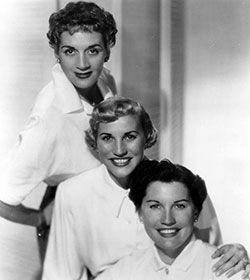
The most popular female trio in the 1940s consisted of sisters Patti, Maxine and LaVerne Andrews. They left Minneapolis, Minnesota, in their teens, and hit the big time in New York with a recording of "Bei Mir Bist Du Schön ♫," a Yiddish folk song that had been given new lyrics by Sammy Cahn. They went on to record many more giant hits, appearing in a half dozen movies and becoming the favorite vocal group of the American military forces during World War II. They were frequent guests on the radio shows of Bob Hope, Bing Crosby, and others because of their exuberant delivery and smart musical arrangements. Songs such as "Booglie Wooglie Piggy (Glenn Miller recording) ♫" and "Boogie Woogie Bugle Boy From Company B ♫" caught the boogie woogie fever that was sweeping the United States in the 1940s.



