
Overview
As we saw in earlier lessons, solo singers became increasingly important during the 1930s. Singers such as Ella Fitzgerald and Bing Crosby built long, successful careers with their interpretations of jazz and Broadway standards. More and more singers followed in this mold in the 1940s and early 1950s, including Frank Sinatra, Perry Como, Patti Page, and Doris Day. Singing groups were common as well, such as the Ink Spots and the Boswell Sisters. Although many singers began in the Broadway or big band mold, many branched out into covers of all types of tunes from a variety of genres.
Objectives
- Examine a number of popular singers and singing groups from the 1940s and 1950s
- Examine how each singer or group offered a unique perspective for the interpretation of standard tunes
- Recognize the different interpretations of the same standard
- Examine how each artist was able to create an identity while performing much of the same repertory
The Ink Spots
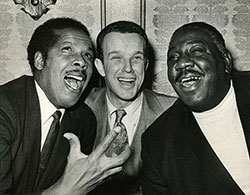
Jerry Daniels formed the Ink Spots in 1934 with Charles Fuqua, Ivory Watson, and Orville "Hoppy" Jones. When they returned from England after their first tour, Bill Kenny replaced Daniels, and they began to establish their signature style—an opening chorus with Kenny in a lovely high falsetto, followed by Hoppy Jones’ dramatic recitation in a rich, resonant, baritone voice, and then a four-part conclusion to the tune. In 1939, "If I Didn't Care ♫" put them into orbit, and they appeared with Glenn Miller at the New York Paramount Theater.
They soon became a featured attraction at the Apollo Theater in Harlem. For a while, they were so much in demand that after their show at the Apollo, they would race downtown to do a late show at the Famous Door, a jazz club on 52nd Street. To get through the Manhattan traffic, they rented an ambulance and crew to help them reach their destination on time. Among their memorable hits were "We Three (My Echo, My Shadow, and Me) ♫" (1940), "Into Each Life Some Rain Must Fall ♫" (1944, with guest Ella Fitzgerald), and "For Sentimental Reasons (1947).



