
Objectives
- Recognize the differences between the Medieval and Renaissance periods in terms of society, religion, art, science, and freedom.
- Explain how Renaissance musicians made their living.
- Use relevant musical vocabulary to analyze Renaissance a cappella singing.
- Distinguish the characteristics of Renaissance music, and differentiate between Renaissance music and Medieval music.
- Illustrate how composers used the motet, a sacred genre with a Latin devotional text, to experiment in musical style and texture.
- Describe how Renaissance composers set texts from the Ordinary of the Mass for their polyphonic Masses.
- Describe how instrumental dance music was performed by professional and amateur musicians.
Aspects of Art in the Renaissance (1450-1600)
Painting and Sculpture
In the early Renaissance, artists discovered the concept of perspective, the technique that makes a painting or drawing appear three-dimensional, as if it is disappearing out of the back of the canvas.
In addition, Renaissance figures are represented much more realistically and with greater individuality and care than their predecessors; the detached figures of medieval paintings are replaced with expressive, lively, and emotive people.
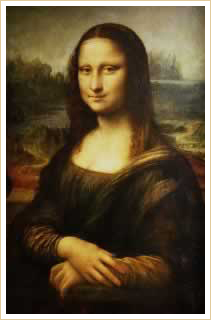

Leonardo da Vinci's work and fame spread beyond art, into scientific discovery and inquiry.

The idea of rebirth referred specifically to a process of rediscovering the works of the ancient Greek and Roman masters. During the Renaissance, the center of the art world was Italy, where artists of the period constitute some of the most famous names in art history. Raphael (1483-1520) and Botticelli (1445-1510) created vivid and accurate renditions of the human form. Leonardo da Vinci's (1452-1519) work and fame spread beyond art, into scientific discovery and inquiry. Michelangelo (1475-1564) not only worked with stone and canvas, but also wrote poetry.
Literature
The important literature of the age ranges from the philosophical/religious writings of Martin Luther (1483-1546) to the works of Miguel de Cervantes (1547-1616). The best-known literary figure of the Renaissance is the English playwright William Shakespeare (1564-1616). The Renaissance introduced the first Western artists who made a lasting impact on different aspects of human culture. As we shall see, the same can also be said of some of the era's composers.



