
Objectives
- Relate how Romantic poets and artists abandoned traditional subjects, turning instead to the passionate and the fanciful.
- Relate how the Industrial Revolution impacted the technological development and affordability of musical instruments.
- Analyze how the orchestra grew in size and sound as new instruments were introduced and composers demanded greater levels of expression.
- Illustrate how Romantic composers explored nationalistic folklore and exotic subjects.
- Identify the form of romantic period songs, including strophic, through-composed, and the modified strophic forms.
- Examine the German art song (or Lied) as a favored romantic period genre.
- Discuss how the music of Franz Schubert impacted romantic period music.
- Discuss how the music of Frédéric Chopin impacted romantic period music.
- Trace the ascendance of program music in relation to absolute music.
- Summarize how political unrest throughout Europe stimulated the formation of schools of musical nationalism in Russia, Scandinavia, Spain, England, and Bohemia among other countries.
- Differentiate between the distinct national styles of romantic opera in France, Germany, and Italy.
- Discuss how the Italian nationalist composer Giuseppe Verdi impacted romantic period music.
- Trace how choral music became a popular artistic outlet for the middle classes.
- Discuss how the Russian composer Pyotr Ilyich Tchaikovsky impacted romantic period music.
The Romantic Period (1820-1910): Aspects of Art and Music Characteristics
The Artist in Society
Artists—the voice of the people—remained a vital part of society in the Romantic era. During the Romantic era there was a reaction against the traditional view of the artist's role in society. During the Classical era, artists struggled to find an individual voice in cultures that did not always promote individuality. By contrast, the Romantic aesthetic was based on the belief that each human is a unique individual, with a distinct, creative voice and vision. Thus, a general emphasis on the individual was an important aspect of Romantic art. The artists of the Romantic era placed importance on nature, the supernatural, the individual, and emotions.

The Romantic aesthetic was based on the belief that each human is a unique individual, with a distinct, creative voice and vision...

The Romantic era was, however, also wrought with conflicts and contradictions. The emphasis on the artist as an individual, characterized in the portrait of Schubert performing to a small gathering of friends, stands in contrast to the figure of the artist as a celebrity, exemplified by Paganini’s and Liszt's appearances in front of thousands of worshipping fans. The desire of Brahms and Verdi to maintain Classical traditions in music contrasts against Wagner and Liszt’s desire to create new forms.
Painting
Romanticism in the visual arts extends roughly from 1800 to 1850. Where the classical and neoclassical periods cultivated emotional restraint and clarity of form and expression, romantic outpouring is reflected in the paintings of Francisco Goya and Ferdinand Delacroix, although it is probably the life and work of Vincent Van Gogh that most aptly exemplifies the extremes of romanticism. In the late 19th century, impressionists such as Edouard Manet, Edgar Degas, and Claude Monet influenced all of the arts, including music. The work of Henri Rousseau, for example, anticipated 20th century primitivism.
Sculpture
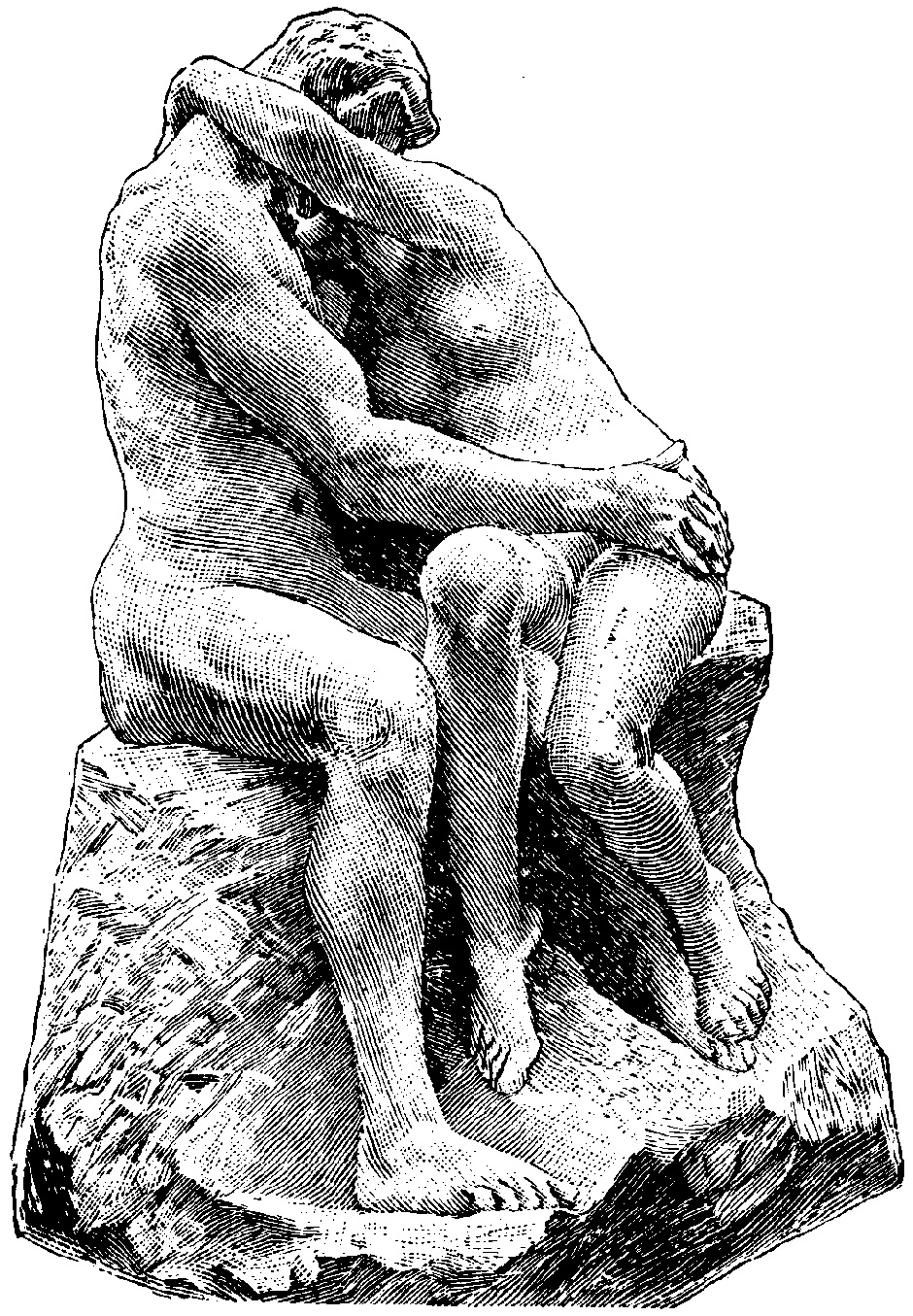
Sculpture in the Romantic era was naturalistic and emotional. Two important pieces of the time were both called The Kiss. Auguste Rodin’s 1886 version was emotional and naturalistic; Constantin Brancusi’s, sculptured a few decades later, was much more simplistic, focusing more on the form rather than emotion.
Literature
In the early part of the century, writers emerged as some of Romanticism’s leading proponents. Novelist Victor Hugo in France, poets John Keats and Percy Shelley in England, and Henry Wadsworth Longfellow in the United States are among the writers who reflected the Romantic aesthetic in their works. Later, Charles Dickens, Georges Sand, Edgar Allan Poe, Alexandre Dumas, Herman Melville, Emily Dickinson, Walt Whitman, Leo Tolstoy, Fyodor Dostoyevsky, and Mark Twain created some of the world’s most enduring literary works. Karl Marx, Friedrich Nietzsche and Sören Kierkegaard wrote philosophical works that sought to change humanity’s view of itself.
In the mid-1880s the age of the realistic novel emerged with novelists such as the Brontë sisters and Herman Melville. The new reverence for nature that characterized Romantic thought was illustrated in Ralph Waldo Emerson’s works. Edgar Allen Poe’s "The Raven" exemplified a fascination with the irrational and the supernatural.
Architecture
Until the 19th century, most architecture was constructed in the shell form, in which one layer exists to provide structure and cover. Architecture was generally picturesque and gothic in style. The art of architecture was greatly affected by advances made in the Industrial Revolution. Cast iron, which was more flexible, was beginning to be used over the previously preferred stone.
One great architectural accomplishment that took place during the Romantic era was the Crystal Palace in England. Built by Joseph Paxton and sponsored by Prince Albert, the Crystal Palace was a step forward for modern architecture. In 1889, Gustave Eiffel erected the Eiffel Tower in Paris, France. In 1900, the famous Paris Metro Entrance was also constructed by Hector Guimard.
General Characteristics of Romantic Music
The first important development in 19th-century music was the German lieder, or "art-song" that had been cultivated by relatively unknown composers including Johann Rudolf Zumsteeg (1760-1802), as well as more famous ones such as Mozart and Haydn. These lieder were based on simple folk songs. At the same time, there was a renewed interest in the way words were used in music.
The features of Romantic-era music may be summarized as follows:
- An increased interest in melody, leading to longer melodic lines with increased range and larger leaps. The Romantic melody is often described as being more ‘lyrical’.
- More dramatic harmonic changes and freer use of dissonance.
- Sharper rhythms, often dance-like. Extremely fast or slow tempos and sudden rhythmic changes are not uncommon.
- Freer and more frequent use of rubato as a rhythmic element. Rubato is literally, a "robbing of the tempo." At a performer’s discretion, rubato can be employed to give the tempo the flexibility to speed up or slow down in relation to the original tempo. This technique is often used to showcase the performer’s unique interpretation of a piece. It is more prevalent in solo or chamber music.
- Increasingly larger orchestras and choruses, as an alternative to the Romantic composers’ use of chamber music and lieder. This trait is shown most dramatically in the symphonies of Bruckner and Mahler. The two styles provide an example of Romantic extremes at work.
- Works of increasing length and scope. This trait is probably best shown by comparing Beethoven’s last symphonies with Mozart’s, or by comparing Wagner’s music dramas with Mozart’s operas.
- An interest in folklore and folk music, which will develop into musical nationalism.
- The alteration or, in certain instances, complete disregard for classical forms such as symphony, sonata, and concerto.



Brahms attempted to retire early at age 57, but continued composing until his death seven years later
