
Learning Objectives
- List the characteristics of the Baroque era (1600-1750) in context of social change including religious wars (Protestants vs. Catholics), the exploration and colonization of the New World, and the rise of middle-class culture.
- Identify a new style—monody—that featured solo song with instrumental accompaniment in the Baroque period through listening examples.
- Define figured bass, a shorthand that allowed the performer to supply chords through improvisation.
- Compare and contrast the major-minor tonality system and the equal temperament tuning system.
- Explain the significance of the union of text and music as expressed in the Baroque Doctrine of the Affections and reflected in genres such as opera, oratorio, and cantata.
- Define and compare the genres of opera, oratorio, and cantata.
- Compare and contrast the development of two types of concertos: the solo concerto and the concerto grosso.
- Correctly identify visually and aurally the main keyboard instruments of the Baroque era: organ, harpsichord, and clavichord.
- Describe the main characteristics of J. S. Bach's keyboard music, in particular his Well-Tempered Clavier.
Baroque Period (1600–1750)
Main Characteristics of Baroque Music
Baroque music may be characterized as emotional, experimental, and original. Compared to their Renaissance counterparts, Baroque composers put much greater emphasis on contrast through the use of different textures, pacing, and volume levels. The following section includes brief descriptions of the characteristics of Baroque music.
Mood
Strongly influenced by the Doctrine of the Affections, Baroque composers attempted to embody and sustain a single affection, or mood, from the beginning to the end of a given piece. Even when a piece featured a change of affection, the music tended to stay in the new mood for an extended period of time. Certain rhythms and melodic patterns were linked to specific moods.
Composer: Johann Sebastian Bach
-
"Orchestral Suite No. 3 in D major, BWV 1068: Air"
Form
Ritornello form, featuring a recurring passage or theme that returns throughout a composition (usually in the first or last movements of a concerto or aria) came into vogue. The ritornello was usually played by the tutti (whole ensemble) and returned in different keys throughout the movement, sometimes in incomplete fragments.
Composer: Johann Sebastian Bach
-
"Brandenburg Concerto No. 3, BWV 1048: I. Allegro"
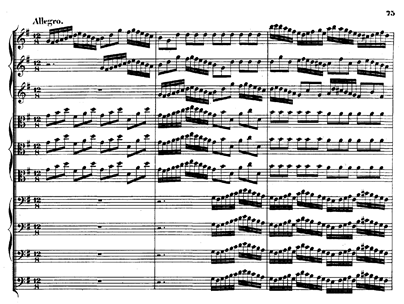
Opening of the 3rd movement of J. S. Bach's Brandenburg Concerto No. 3 in G major BWV 1048.
- Form: Ritornello
- Mood: Energetic and festive mood from beginning to end
- Melody: Although difficult to sing or play, melodies have a clear and distinct thematic contour easily grasped by the ear.
- Rhythm: The pulse is strong, steady, and continuous. Patterns and sequences repeat throughout the piece.
- Harmony: Rapid changes in harmony often make the music feel more rhythmic.
- Tonality: G major
- Texture: Textural features include imitation between the voices and emphasis on contrasting textures.
Melody
- For the most part, Baroque melodies were not easy to sing or play. However, despite their complexity, melodic themes were clear and distinct.
- Gradually, a distinction developed between vocal and instrumental style melodies.
Style
Recitative, a way of singing text with speech rhythms, was introduced early in the century. Later in the period, there was a shift from recitative to highly elaborate arias and instrumental melodies.
Composer: Johann Sebastian Bach
-
"Christmas Oratorio, BWV 248: II. Recitative: Es begab sich aber, zu der Zeit"
There was an emphasis on beautiful vocal tone and technique over all other elements.
Composer: Alessandro Scarlatti
-
"Con voce festiva"
Composer: Giovanni Battista Pergolesi
-
"L'Orfeo: O, Euridice, n'andro festoso"
Melismatic singing—the vocal technique by which one syllable of the text is sung using many pitches— was a favorite device of Baroque composers, especially in liturgical vocal settings. The opposite of melismatic singing is syllabic singing, in which there is a one-to-one correspondence of syllables and notes. Listen to the melismas, also known as "vocal runs," in the following example by Handel. While you are listening for them, can you determine which words are sung in syllabic fashion?
Composer: George Frideric Handel
-
"Messiah: All we like sheep"