
Learning Objectives
- List the characteristics of the Baroque era (1600-1750) in context of social change including religious wars (Protestants vs. Catholics), the exploration and colonization of the New World, and the rise of middle-class culture.
- Identify a new style—monody—that featured solo song with instrumental accompaniment in the Baroque period through listening examples.
- Define figured bass, a shorthand that allowed the performer to supply chords through improvisation.
- Compare and contrast the major-minor tonality system and the equal temperament tuning system.
- Explain the significance of the union of text and music as expressed in the Baroque Doctrine of the Affections and reflected in genres such as opera, oratorio, and cantata.
- Define and compare the genres of opera, oratorio, and cantata.
- Compare and contrast the development of two types of concertos: the solo concerto and the concerto grosso.
- Correctly identify visually and aurally the main keyboard instruments of the Baroque era: organ, harpsichord, and clavichord.
- Describe the main characteristics of J. S. Bach's keyboard music, in particular his Well-Tempered Clavier.
Baroque Period (1600–1750)
Music for Large Spaces
Orchestral Suite
Another popular Baroque form was the suite, a series of movements based on the rhythm and style of certain traditional dances. Suites were written for solo instruments, small groups, and large orchestral ensembles. Common movements included the German allemande, the French courante, the sarabande (originally from Spain), and the English or Irish gigue (jig). Many suites also included the gavotte, a French folk dance characterized by raising rather than sliding the feet. Suite movements were designed to offer interesting contrasts in meter, tempo, and texture. Sometimes, a prelude—a non-dance movement—opened the suite.
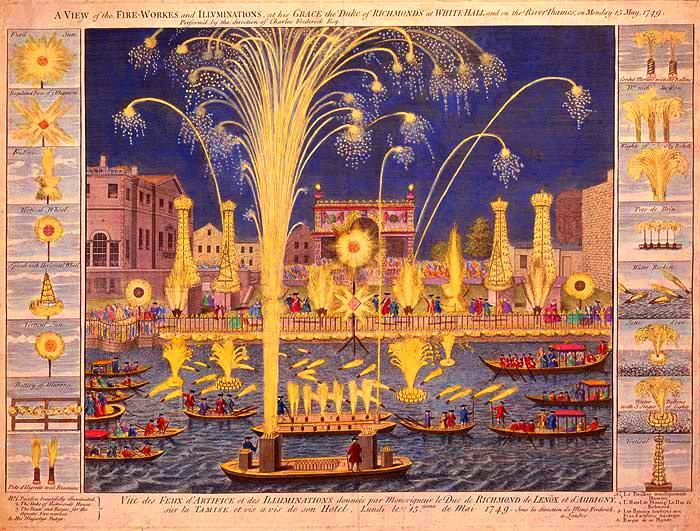
Handel's two most popular orchestral suites are Fireworks Music and Water Music. The Fireworks Music suite was, appropriately, first performed at a large fireworks display, while the Water Music was written for a 1717 party held by King George I on the Thames River. Legend has it that the partygoers rode on one barge floating down the Thames, while Handel and the musicians played on another barge immediately following. Handel may have even composed this suite partly to get back into the good graces of his patron, the newly crowned king (formerly the elector of Hanover), who had recently moved to England from Germany. Handel, of course, was already there, having taken an embarrassingly long leave from Hanover so that he could stay in his favorite city of London. The most famous movement from Water Music is the Alla Hornpipe, based on a boisterous sailor’s dance in triple meter. Follow along with the Listening Guide as you enjoy this popular
Composer: George Frideric Handel
-
"Water Music Suite No. 2 in D Major, HWV 349: Water Music: Suite No. 2 in D Major, HWV 349: II. Alla Hornpipe"
Bach, too, wrote suites for various instruments and ensembles. This next piece, the Air from his Suite No. 3 in D Major, is often called “Air on a G String,” after a transcription for violin and piano made in the late 19th century by the German violinist August Wilhelmj, who was able to play the piece on only one string of his violin, the G string. This particular movement is not based on a dance, but the suite does include a gavotte, a bourrée (a quick French dance in duple meter), and a gigue, in addition to an opening overture. Follow along with the Listening Guide to learn more about the piece. This Air is an expression of the Baroque Doctrine of Affections, which proposed that music is capable of arousing a variety of specific emotions within the listener. At the center of the doctrine was the belief that, by making use of the proper standard musical technique, the composer could create a piece of music capable of producing a particular involuntary emotional response in his audience and, furthermore, that a musical work should awaken one specific mood or emotion in the listener, and maintain it throughout the piece. These techniques and their affective counterparts were rigorously cataloged and described by several 17th- and 18th-century theorists, who maintained, among other examples, that joy could be elicited by large intervals, sadness by small intervals; fury by a roughness of harmony coupled with a rapid melody; and obstinacy by the contrapuntal combination of highly independent (obstinate) melodies.
Composer: Johann Sebastian Bach
-
"Overture (Suite) No. 3 in D Major, BWV 1068: II. Air, "