
Overview
In the early 1940s, a number of innovative and daring jazz musicians began searching for a new style. In after-hours jam sessions, they experimented with new melodic and harmonic vocabularies that challenged listeners and musicians alike. This music would come to be known by its onomatopoeic description: bebop.
In this section, we will first focus on the two principal innovators of this new jazz style: Charlie Parker and Dizzy Gillespie. We will also discover how the swing-style jazz of Count Basie provided a basis for the transition to bebop and the advent of the modern jazz era. In the second half of the section, we will discover other influential musicians who helped shape bebop and modern jazz.
Objectives
Upon completion of this lesson, you will be able to do the following:
- Identify Charlie Parker and Dizzy Gillespie as the principal innovators who contributed to the development of bebop
- Appreciate bebop as a new approach that ushered in modern jazz
Bebop
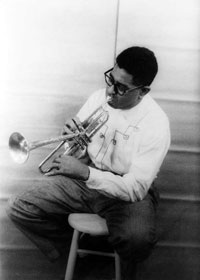
Although bebop drew from the Kansas City style of swing, in many respects, it was still revolutionary. Bebop was considered an underground jazz movement in its early years. Its developers and practitioners met in the after-hours of New York's jazz clubs, experimenting with new harmonic and melodic idioms during jam sessions that would sometimes last until dawn.
In the early-to-mid-1940s, jazz reached a peak in popularity with big-band swing. Some of the same sidemen who were the star soloists of these big bands were leading a "double life," pioneering the new bop approach to jazz improvisation in small combo settings. From this point forward, the cutting edge of jazz would enjoy an aura of the subversive.
This new approach to jazz emphasized speed and agility. It required unprecedented mastery of the instrument. Simply stated, bop harmonies and melodies were more complex than any jazz style that preceded it. Bop tempos were faster than jazz had ever been. This was not dance music, and it was never really intended to be popular. It was jazz for the artists themselves and for true jazz lovers.
Bop established the primacy of virtuosic solo improvisation. From this time forward, the measure of great jazz would be, first and foremost, the measure of the artistry and virtuosity of the solo improvisers.
To hear a great example of this new approach, listen now to Charlie Parker and Dizzy Gillespie, the two greatest innovators of bebop, playing on Leap Frog ♫. Notice immediately how much faster and more complex the music is compared to what we've heard.
Charlie Parker, Leap Frog ♫ (Charlie Parker), New York, June 6, 1950. Charlie Parker, alto saxophone; Dizzy Gillespie, trumpet; Thelonious Monk, piano; Curly Russell, bass; Buddy Rich, drums.



Charlie Parker's nickname "Bird" (or "Yardbird") was reflected in some of the songs he composed, such as "Ornithology," "Bird of Paradise," and "Yardbird suite."
