
Overview
In this section, we will focus on the late 1950s and early 1960s to learn more about Miles Davis and two of his most influential sidemen: Bill Evans and John Coltrane. We will consider the significance of Davis' musical compositions and those of his fellow musicians, and examine how their works continue to impact jazz even to the present day.
Objectives
Upon completion of this lesson, you will be able to do the following:
- Identify many of the contributions of Miles Davis to jazz
- Define modal jazz
- Recognize the contributions of Bill Evans to jazz—most especially to jazz piano
- Recognize the contributions of the members of Bill Evans’ most celebrated trio
- Recognize the contributions of John Coltrane as saxophonist, composer and bandleader
- Recognize the contributions of the members of John Coltrane’s classic quartet
Bill Evans
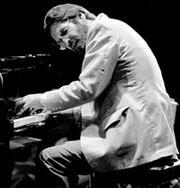
Bill Evans' contribution to Kind of Blue ♫ is arguably the album's defining element. His chord voicingsA term referring to the particular arrangement of the notes in a chord. in the head arrangement of So What ♫, his opening vamp in Flamenco Sketches ♫, his compingA term that refers to the improvisational techniques deployed when a pianist plays the accompanying chords in a jazz setting. and solo style throughout that exude grace and calm — these are distinctive features underlying the album's greatness. Miles Davis was credited at the time as the composer of all the album's pieces, but it's clear in retrospect that Evans was an essential collaborator on several of these, none more so than on Blue in Green ♫.
Blue in Green ♫ is a 10-bar circular form, taken at a slow, ballad-like tempo. After a piano introduction (0:00-0:18), Miles Davis takes two choruses on muted trumpet (0:19-1:47), staying close to the melody. Bill Evans takes a solo chorus (1:48-2:26), followed by John Coltrane (2:27-3:09). Then Evans takes another in literal double time (3:10-3:31), as he speeds up the chord progression to complete it in five bars rather than ten. Miles solos over two more choruses (3:32-4:55), offering up some of the most sensitive and poignant sounds that have ever come from a trumpet. Evans closes with a final chorus (4:55-5:37), and we hear Paul Chambers once again pick up his bow, this time as accompaniment.
Pay particular attention to Bill Evans' second solo chorus (3:10-3:31). In this trio setting, with Paul Chambers on bass and Jimmy Cobb on drums, Evans suggests the direction he will take with his own trio — one in which the beat is more suggested than sounded; one in which there is greater give-and-take between piano and bass, in which the bass is not just walkingA style of playing bass in which the strings are plucked on every quarter-note beat. but becomes more contrapuntally interactive; that is, with marked counterpointThe technique of combining two or more melodic lines in such a way that they establish a harmonic relationship. between the instruments. Let's listen now to the Evans-Davis composition Blue in Green ♫.



The Village Vanguard is one of New York's celebrated jazz rooms, opened in 1935 by Max Gordon
