






Swing and Big Band
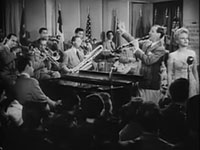
Dixieland jazz was enormously popular during the first part of the twentieth century, and during the 1920s, a new type of jazz began to evolve. Dixieland remained popular, but this type of jazz, known as swing, grew to accommodate the needs of dance halls during the Prohibition and the Roaring 20s. Swing bands were much larger than Dixieland combos, and they featured multiple trumpets, trombones, and saxophones, plus a rhythm section of piano, bass, and drums. Swing bands performed at large venues, such as Harlem’s Cotton Club, and they provided the music for people to dance, drink, and party into the wee hours of the morning.
The majority of swing bands during this period were African American, although white bands, such as those led by Paul Whiteman and Benny Goodman, gained greater exposure in the media and from record companies than did their African American counterparts.
Most swing bands were immaculately dressed and expertly rehearsed, and they read music from compositions or arrangements. Swing compositions included 12-bar bluesa popular genre of African American music that consisted of twelve-bar phrases arranged over a standardized harmonic progression arrangements of popular songs, free forms, and contrafacts. In a contrafact, the composer borrows the harmonic infrastructure from a popular song but writes an entirely new melody. One of the most popular bases for contrafacts of all time is the harmonic structure of the Gershwins’ "I Got Rhythm ♫." Students of jazz, even today, must know the harmony of this song inside and out.
One of the most loved swing composers of all time is Duke Ellington. During his time leading the orchestra at the Cotton Club, Ellington explored the instrumental colors of the jazz orchestra. He hired theatrical musicians who specialized in exotic sounds, and then he gave them free reign. Soon everyone was trying to copy the muted trumpet growls of Cootie Williams, and the liquid beauty of alto saxophonist Johnny Hodges. Ellington also encouraged his musicians to use a variety of mutes to produce creative tone colors and timbres. These new sounds caught the attention of journalists, who began calling them "jungle sounds," a term that suggests primitive, animalistic behavior. Critics and white audiences at the time often attributed negative racial stereotypes to black musicians, their music, and the effects their music produced on listeners and dancers. Publicity material for the exotic and erotic Cotton Club shows frequently used the term "jungle music" to draw curious white spectators into the Harlem club.
In Ellington’s compositions, he frequently sought new and interesting sounds, which he created by combining and recombining groups of instruments, encouraging his musicians to create special effects, and focusing on the soloists. Many of Ellington’s compositions from this period feature long instrumental solos by a single musician, which allowed that musician to shine. Ellington frequently wrote compositions with a specific soloist in mind. For example, Cotton Tail is typical of Ellington’s work from this period. Cotton Tail ♫ (1940) is a contrafact in "I Got Rhythm ♫," which means that the harmonic structure of this piece is borrowed from the Gershwins’ song. However, the new melodies, rhythms, and harmonies that Ellington creates mark this as an entirely new composition. Featuring a lengthy solo by tenor saxophonist Ben Webster, Cotton Tail ♫ is representative of Ellington’s use of contrafact, instrumental effects, and his focus on individual soloists.
As with Dixieland jazz, white swing bands often had more commercial success and had easier times securing recording contracts. White bandleaders such as Paul Whiteman, Benny Goodman, and Artie Shaw toured widely during the 1920s and 1930s, and they sold out far more venues and sold many more recordings than their black counterparts. However, bandleaders such as Benny Goodman used their prestige to promote their African American colleagues. Goodman’s band used arrangements and compositions by Fletcher Henderson, and Goodman also led one of the first racially-integrated ensembles. For all of its biases and misconceptions, jazz was the first exposure to African American music that many white Americans ever experienced.



