



The Major Scale
Definition
A major scale is a seven-note diatonic scale with a specific pattern of whole (W) and half (H) steps.
As we have learned, diatonic scales do not repeat or skip any letter names. The scale of C Major, for example, is spelled with the letter names C, D, E, F, G, A, and B (as shown below). Although the last C is not considered to be a new note in the scale, it completes the scale by returning to the initial note. Thus, major scales are named for their first and last note including any accidental that it may have, e.g., C-sharp major, or B-flat major.
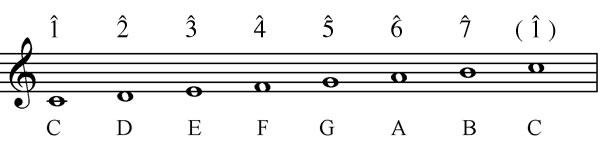
C major scale

Scale Degrees
The steps in a scale are known as scale degrees. A major scale has seven scale degrees in it: , , , and so on, as labeled in the example above. (The ^ sign above the numbers is commonly used above scale degree numbers.) , representing the pitch that starts and ends the scale, is also known as the tonic. All scales are named after their tonics. For example, the C major scale is called a C scale because it starts (and ends) on a C. Similarly, the first note of a D scale is a D, an E-flat scale starts on an E♭, and so on.
The Major Scale Pattern
The major scale has a specific pattern of whole and half steps, which can be discovered by playing the C major scale on the keyboard. Play all of the white keys from C to C (in ascending order) on the virtual piano below: C, D, E, F, G, A, B, C. You will notice that half steps occur naturally between E and F and between B and C, because there are no black keys separating these white keys. All of the other steps in the scale are whole steps (C→D, D→E, F→G, G→A, and A→B).
Practice the major scale pattern in the Virtual Keyboard.
There are thus five whole steps and two half steps in a major scale, and they occur in the following pattern: W W H W W W H
You should memorize this pattern now, because all major scales use this same pattern of whole and half steps. If a scale doesn't follow this pattern, it is not a major scale. If you can remember this pattern, you can spell any major scale.
The interactive example below will help you memorize the distribution of whole (W) and half steps (H) in the major scale. Click on "Show Me" to see and hear the scale. Notice that the two half steps in the scale occur between scale degrees and , and between and (or ). You can also click on a W or a H to hear the difference between whole and half steps.
The Major Scale Pattern
Tetrachords
Notice how the whole tone (W) between and in the example above divides the scale into two equal halves of four notes each. These four-note groups are called tetrachords [from the Greek, tetra (four) chorde (string or note)]. The green W represents the whole step that separates the scale into two equal tetrachord patterns: WWH. Thinking of these WWH tetrachord groups separated by a W will also help you remember the major scale pattern.

Remember:
- There are five whole steps and two half steps in a major scale.
- In a major scale, half steps (H) always fall between and , and between and . The distance between all of the other scale degrees is a whole step (W).
- Any scale that follows the WWH W WWH pattern is a major scale.
- Tetrachords divide the scale into two equal halves of four notes each.
The Key of a Composition
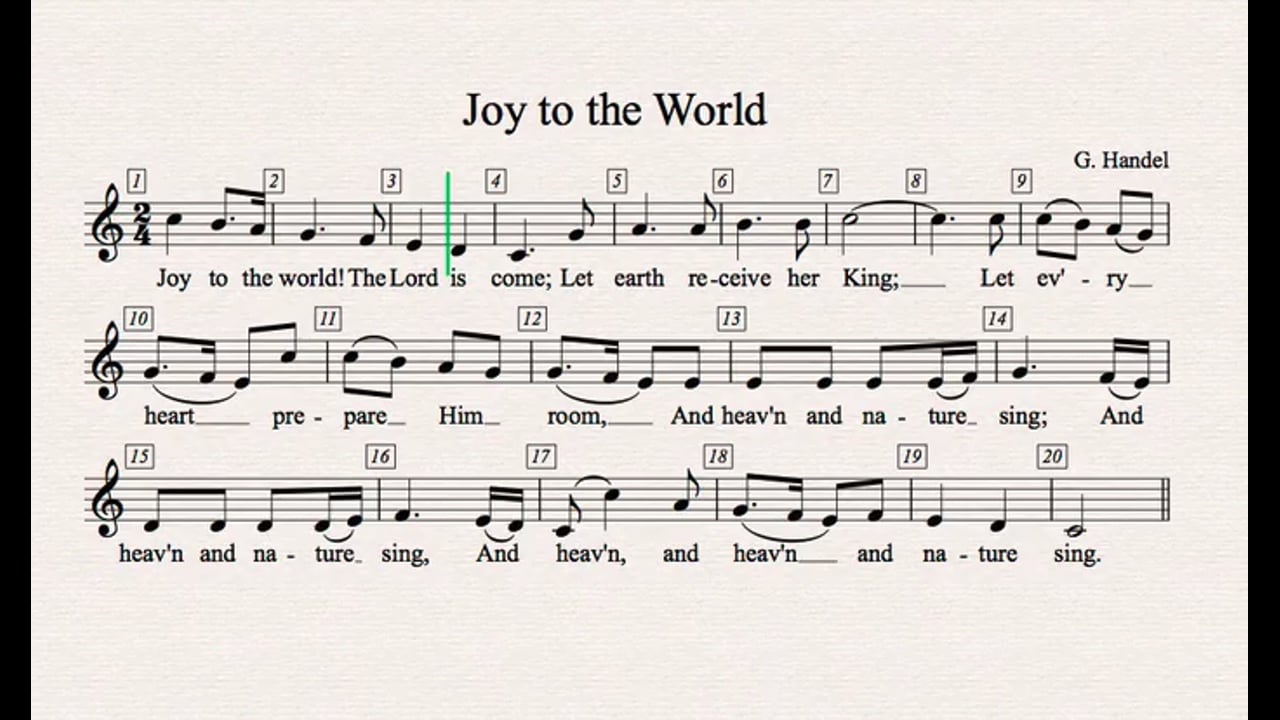
A composition that is based on a given scale is said to be in the key on which that scale is built. For instance, a composition that is based on the scale of C Major is said to be in the key of C Major if most (if not all) of the notes that it is based on come from the C major scale. "Joy to the World" is an example:
Joy to the World
"Joy To the World" by George Frideric Handel (1685-1759) illustrates a short composition in the key of C major.
Notice that this piece:
- Starts and ends on a C.
- Starts with a descending C major scale.
- Uses all the notes in the scale of C major.
- Does not use any notes that are NOT in the key of C major.
- Uses the tonic note C to emphasize important words like "joy," "king," "heaven," and "sing."

Core Skill
- Recite the whole and half step pattern of the major scale quickly and accurately.
- Recognize whole and half steps within major scales quickly and accurately.
- Divide a major scale by tetrachords quickly and accurately.