
Objectives
Be ready to...
- Relate the social, cultural, and political background during the Medieval period (500-1450) to the function of music during this time.
- Characterize the music of the early Christian church, i.e., Gregorian chant.
- Describe the difference between the Proper and the Ordinary of the Mass.
- Examine the influence of the Cathedral of Notre Dame as a center for organum in medieval music.
- Describe the differences between troubadours and trouvères in medieval secular music.
- Trace the rise of secular polyphonic chansons set to fixed text forms (rondeau, ballade, virelai) in the French Ars nova.
- Define and classify the instrumental music of the medieval period.
- Trace the four major developments that took place in Western music during the Middle Ages: the development of pitch and rhythmic notation; the transition from monophony to polyphony; the initial stages of regularly metered music; and the development of the motet and instrumental music.
Aspects of Art in the Middle Ages (500-1450)
The Graphic Arts
The goal of the medieval artist was not to depict the subject realistically. Instead, artists of this period attempted to convey the subject's emotional state, which was usually either joy in serving God or horror at the prospect of hell.
The paintings by Giotto di Bondone (c.1267-1337) are regarded as crucial in the development of Western art. Despite his lack of knowledge of anatomy and perspective, Giotto was consistently able to portray characters in an emotionally compelling and natural way. The Apparition at Arles shows an impressive sideways view of a monk's house, its back wall divided by three arches.
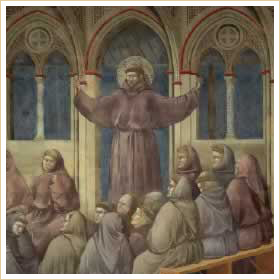
Even though the friars are viewed from behind, Giotto manages to effectively convey their different attitudes. Note the variety of color in their garments. This painting is part of a series of frescoes in the Church of San Francesco at Assisi. Giotto was influenced by the work of the Roman artist Pietro Cavallini (c.1250-c.1330).
Architecture
Medieval architecture deserves a special mention. The early medieval churches were Romanesque buildings: functional, if not always inspiring.
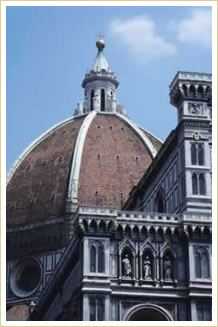
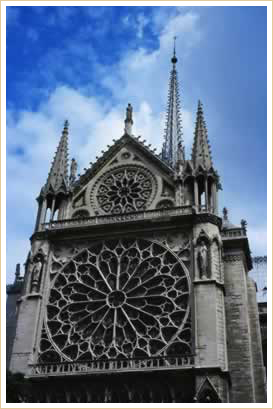
However, with advances in construction, including ribbed vaulting and the flying buttress (a structure that allowed walls to be built higher), cathedrals became much larger and more ornate. Especially interesting is the relationship between architecture and sculpture evident in the ornamentation of medieval buildings. The octagonal dome of the Florence Cathedral, built without the aid of scaffolding, was considered the greatest engineering feat of its day. Filippo Brunelleschi (1377-1446), one of the initiators of the Italian Renaissance, was the Florentine architect responsible for its design. Although better known as a painter, Giotto was also involved in its construction. French cathedrals such as Notre Dame in Paris and the Notre Dame Cathedral at Amiens are glorious examples of Gothic architecture.
Literature
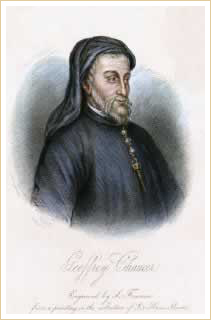
A number of significant literary works were written in the Middle Ages, most notably Geoffrey Chaucer's (1343-1400) Canterbury Tales, Dante Alighieri's (1265-1321) Divine Comedy, and Giovanni Boccaccio's (1313-1375) Decameron.
Another important figure in the arts of this period was Hildegard of Bingen, Abbess of Rupertsberg (1098-1179). Hildegard was a nun who wrote some of the first surviving original musical compositions as well as poetry and prose based on science and natural history. We will study her music in more depth later.
Online Resources



