
Learning Objectives
- Learn about the plagal cadence and the deceptive cadence.
Cadences III: Other Cadences
Plagal Cadence
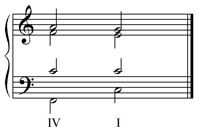
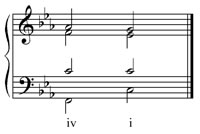
There are two other types of cadences that occur with some regularity in music (though they are not nearly as common as authentic or half cadences). One is the plagal cadence. Like the authentic cadence, the plagal cadence arrives on the tonic, but it precedes this tonic with a subdominant chord, creating a IV - I progression at the end of a phrase (or iv - i in minor). The plagal cadence is conclusive, but not as strong as the authentic cadence. Here are two examples: one in C major and one in C minor. Click on the speakers below to hear them played.
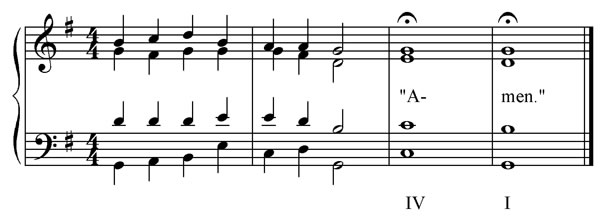
The plagal cadence is sometimes called the "Amen cadence" since it frequently accompanies those words at the end of church hymns, as in the example below.
| Remember |
|
Deceptive Cadence
The final type of cadence we will examine is the deceptive cadence. The name "deceptive" comes from the fact that the phrase sounds to the listener like it is going to end by moving from the dominant to the tonic, but instead it goes somewhere else. The deceptive cadence is similar to a question mark at the end of a sentence. The most common type of deceptive cadence is the progression V - vi (or v - VI in minor). Here is an example of a phrase that ends deceptively. Click on the music to hear it played.
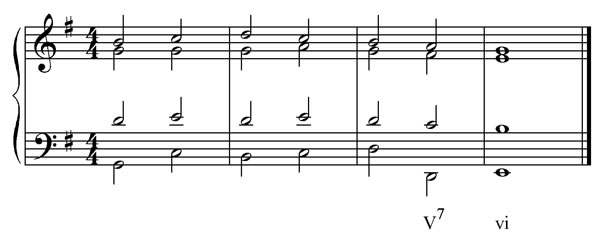
The ear expects this phrase to resolve back to the tonic, so the unexpectedly dark resolution to a minor vi chord is a bit of a surprise.
| Remember |
|
An Example from the Literature
To conclude our study of cadences, we will now look at an example from the literature that makes use of all of the types of cadences we have discussed: "Wachet auf" (Sleepers Wake!) from Bach's Cantata no. 140. Open and print out the score, then read the comments below while listening to the music.
Missed Animation: "Wachet auf ruft uns die Stimme"
| J. S. Bach's cantata "Wachet auf ruft uns die Stimme" (BWV 140) ends with this simple four-part chorale in E-flat major. This chorale is a very good example of different types of musical cadences.
It is quite easy to hear (and see) the phrases in this piece because most of them are separated by long rests. The first phrase (measures 1-5) ends on a B-flat triad; this is a V chord in E-flat major, making it a half cadence (labeled "HC"). This second phrase (measures 6-11) also ends on the dominant, creating another half cadence. The last phrase in the opening section (measures 12-16) then "answers" the two previous half phrases with a perfect authentic cadence (V7-I in E-flat major, labeled "PAC"). This first section is then repeated. The second half of the piece begins with a short phrase (measures 17-20) that ends questioningly, with a deceptive cadence (V-vi, labeled "DC"). This is answered by another short phrase (measures 21-24) that begins the same but ends more definitely, with an authentic cadence (V-I). The following phrase (measures 25-27) also ends on the tonic, but since the soprano ends the phrase on scale degree 3 (the pitch G), this is an imperfect authentic cadence (labeled "IAC"; the viio6 acts as a weaker substitute for V in this cadence.) The last two phrases are not separated by rests, but it is fairly clear to the listener that there is another brief deceptive cadence in measure 32, followed by a very strong perfect authentic cadence at the end of the piece. |
Thus we see that in music, phrases are like musical sentences that end with different types of punctuation (cadences) and that these phrases combine into larger musical "paragraphs," "sections," and "chapters." The study of musical form investigates all of these musical units, from the smallest motives and phrases to large-scale connections between much longer sections of music. Such a study is unfortunately beyond the scope of this course.