
Overview
This section examines how Miles Davis became a driving force in the effort to combine jazz and rock music to form a new style of jazz known variously as jazz fusion, jazz-rock fusion, or simply fusion. We will focus particularly on Davis’ seminal 1969 album, Bitches Brew.
A number of the musicians who worked with Miles Davis in forging the new fusion style of jazz eventually formed their own bands. We will consider the work of Miles Davis’ sidemen as leaders in their own fusion bands, particularly Wayne Shorter, Joe Zawinul, John McLaughlin, and Herbie Hancock. We will also look at other artists who explored various currents in jazz-rock fusion.
Finally, having already examined Bill Evans and Herbie Hancock in some detail, we'll take a closer look at two more trend-setting Miles Davis keyboardists, Chick Corea and Keith Jarrett, and their work as pioneers in acoustic settings.
Objectives
Upon completion of this lesson, you will be able to do the following:
- Identify influential jazz-rock fusion musicians and their contributions
- Appreciate the accomplishments of Chick Corea and Keith Jarrett
- Identify musicians who collaborated with Chick Corea and Keith Jarrett
Chick Corea
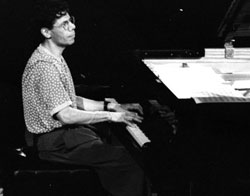
When Herbie Hancock left the Miles Davis Quintet in 1968, Chick Corea became Davis' pianist-keyboardist. Like Hancock before him, Corea had absorbed many of the same bop and post-bop influences in his playing. In addition, Latin music has been — and remains — an important influence, along with the music of such twentieth-century classical composers as Bela Bartók (Allegro barbaro, BB 63 ♫).
Chick Corea (b. 1941) had already established himself as a combo leader with his landmark 1968 trio record Now He Sings, Now He Sobs ♫ when Miles Davis summoned him later that year.
Recall that we heard Steps - What Was ♫♫, a track from that album, in the beginning of this course. Let's revisit that piece, with the benefit of considerable contextual knowledge. The bebop style of Bud Powell, as well as the trio work of Bill Evans, Scott LaFaro, and Paul Motian clearly informs Corea's collaboration with bassist Miroslav Vitous (b. 1947) and drummer Roy Haynes. Corea, though, has forged his own style, distinguished as much by his compositional brilliance as his crisp, dazzling, percussive playing.
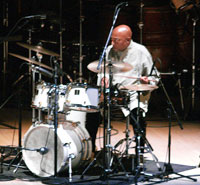
Listen again to Corea's composition Steps - What Was ♫♫. From the outset, Corea's imaginative, improvisatory introduction (0:00-0:47) signals that we will be joining him on a rare sonic journey. The 12-bar theme (0:47-0:57), which is repeated (0:57-1:06), does not sound like a standard blues form. That's because it's divided into two 6-bar units, each of which is introduced by a repeated bass note figure. Corea's solo over the next three and a half minutes demonstrates a wealth of musical ideas that pour forth in abundance, and these ideas stimulate responsive interactions among the trio. The group radiates a bright energy that is only partly the result of the very brisk tempo.
Following the return of the headA synonym for melody. and a brief codaThe concluding passage of a piece of music, typically forming an extension to the basic structure. , Roy Haynes' extended drum solo (5:04-7:31) bridges "Steps" to "What Was." This second tune of Corea's — in triple meter and played at a remarkably fast tempo — exudes a distinctly Spanish flavor with its Phrygian modal elements. Interestingly, it's a greatly expanded AAB form (7:54-8:34), in which the A section is slightly longer than the B section. Following Corea's solo choruses, Miroslav Vitous also takes a turn soloing on bass (11:10-12:14), while Roy Haynes drops out to allow more focus on the bass player. A return to the head brings the piece to a close.



"Chick is the fourth-most-nominated artist in the history of the Grammys, with 63 nominations. He's also earned 3 Latin Grammy Awards, the most of any artist in the Best Instrumental Album category."
