



Classical Period (1750-1825)
Instrumental Music
Most instrumental music up to the 20th century had a specific organizational plan similar to the way a story is constructed. To make sense, a story must have a beginning, middle, and an end. If the author doesn't follow the rules of storytelling, the reader can get completely lost. Understanding the set of rules for composition (formal criteria) allows us to objectively judge how successful a composer has been from a formal point of view.
By the end of the Classical period, clear formal criteria had been defined for different genres of instrumental music. The challenge to composers was to create something new and exciting within those genres while working within the sonata-allegro form. The following sections serve as short introductions to Classical genres.
Symphony
Symphonies are compositions for orchestral ensembles. In the early years of the Classical period, the German city of Mannheim was the most important center for symphonic composition and performance. Located on the Rhine River about 50 miles north of the current German/French border, Mannheim was the birthplace of the first important instrumental trends of the new era as exemplified in the performances of the Mannheim orchestra, conducted by Johann Stamitz (1717-1757). The orchestra's precision and flexibility demonstrated that an entire group of musicians could perform gradual, dynamic changes accurately and expressively. Composers were quick to adopt the techniques of gradually increasing (crescendo) or decreasing (diminuendo) volume. The Mannheim school is also credited with adding the minuet and trio to the three-movement format. The minuet and trio of Stamitz’s Symphony in E-flat major, Op.11, No.3 (1754) illustrates that structure.
Composer: Johann Stamitz
-
"Symphony in E Flat Major, Op. 11, No. 3: III. Menuetto"
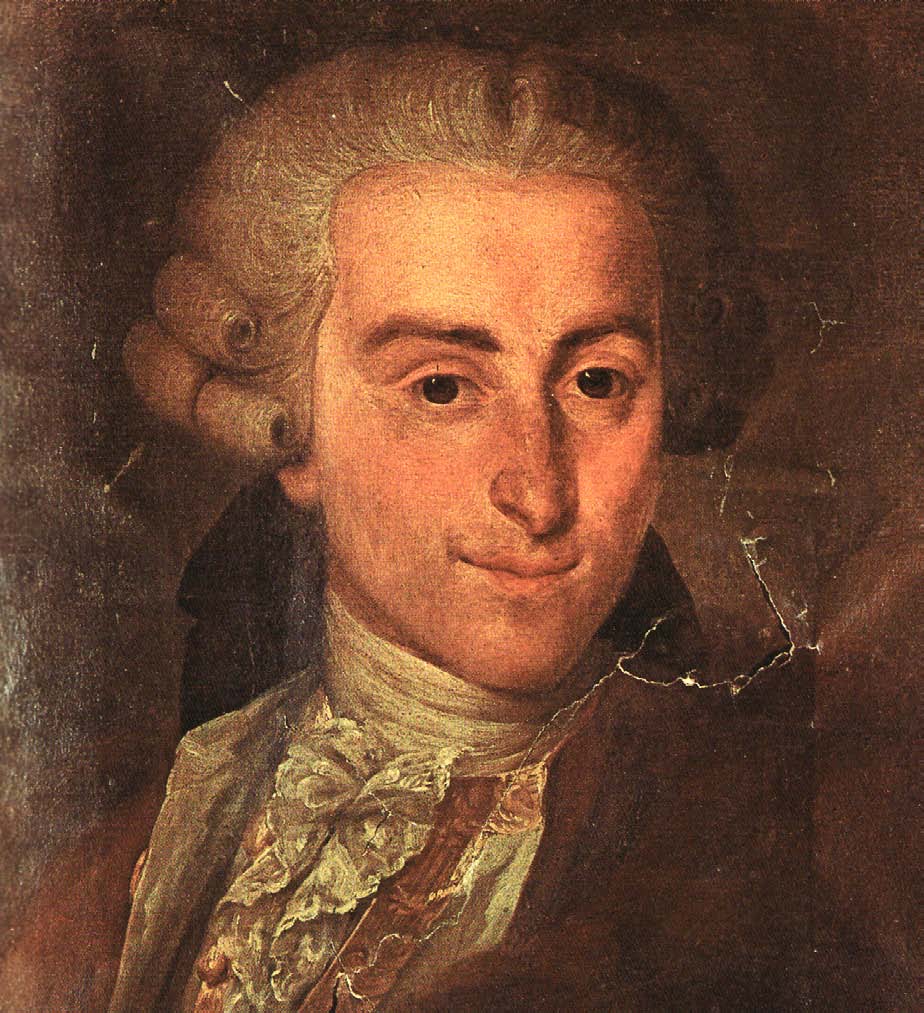
It must be noted here that the Germans shouldn't get all the credit for developing the symphony. In 1744, an Italian, Giovanni Battista Sammartini (1701-1775), wrote his Symphony in F, a work that many consider the first prototypical symphony.
The symphony started as introductory music in Italian operas. In the beginning, these instrumental pieces, which usually had three movements, were also known as overtures. One of the most famous overtures of all time is the overture to The Barber of Seville by the Italian classical composer Gioacchino Rossini (1792-1868).
Composer: Gioachino Rossini
-
"Il barbiere di Siviglia (The Barber Of Seville): Overture"
Over time, these instrumental music pieces became so popular that audiences wanted to hear them without the opera, so they were used as the first pieces in concert performances. Note that the word symphony comes from the Italian word for overture, sinfonia.
The Classical symphonic ensemble, which has remained basically unchanged up to the present day, consists of 12 first violins, 12 second violins, six violas, eight cellos, four double basses, eight woodwinds (two flutes, two oboes, two clarinets, and two bassoons), four brass (two trumpets and two horns), and percussion (two timpani).
The Classical symphony usually followed a four-movement structure, in which each movement could be considered a complete, separate composition. Remember the Italian tempo markings from our previous lessons? Composers used those markings as titles for the various movements. A common structure in a four-movement symphony would be the
- first movement: allegro (fast),
- second movement: adagio (slow) or andante (moderately slow),
- third movement: menuetto or minuet (dance-like), and
- fourth movement: allegro (fast).
Haydn wrote 104 symphonies, Mozart wrote 41 (as reported in traditional editions), and Beethoven wrote nine. To illustrate the four-movement structure, listed in the table below are movements from these (and other) Classical composers' symphonies.
(fast)
(fast)
Wolfgang Amadeus Mozart
(slow-fast)
Franz Joseph Haydn
(fast)
Wolfgang Amadeus Mozart
(moderately slow)
Johann Christian Bach
(dance-like)
Wolfgang Amadeus Mozart
(fast)
Ludwig van Beethoven
Composer: Ludwig van Beethoven
-
"Symphony No. 5 in C Minor, Op. 67: I. Allegro con brio"
Composer: Wolfgang Amadeus Mozart
-
"Symphony No. 25 in G minor, K183: I. Allegro con brio"
Composer: Franz Joseph Haydn
-
"Symphony No. 104 in D major, London: I. Adagio-Allegro"
Composer: Johann Christian Bach
-
"Symphony in F major, Op. 3, No. 5: II. Andante"
Composer: Wolfgang Amadeus Mozart
-
"Symphony No. 35 in D major, K385: III. Menuetto"
Composer: Ludwig van Beethoven
-
"Symphony No. 9 in D Minor, Op. 125, Choral: IV. Finale: Presto - Allegro assai"
Chamber Music
As the number of music lovers increased during the 18th century, demand rose for music that could be performed in private homes. Chamber music refers to music that can be played in small rooms by a relatively small number of performers, with one performer for each instrumental part. Chamber music ranges from works for two (duets) to three (trios) to five (quintets) or more instruments, although usually not more than a dozen. The string quartet and sonata were the two most important subgenres of chamber music.
Composer: Wolfgang Amadeus Mozart
-
"Clarinet Quintet in A major, K. 581: I. Allegro"
String Quartet
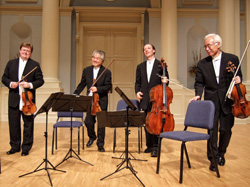
The string quartet is a genre for four string instruments: two violins, a viola, and a cello. Writing music for this group of instruments was very popular among composers during the mid-18th century, mainly because this combination created a perfect balance between high and low sounds. The main melody, played by the violins, is supported by the harmony, which is in turn created by the viola and the richness of the cello's bass line.
The string quartet medium was perfectly suited for the focus on balance, restraint, and symmetry typical of the Classical period, but it has also been used as a vehicle for the most personal musical thoughts of many composers through the ages, including: Mozart (23), Beethoven (16), Johannes Brahms (3), Prokofiev (2), Shostakovich (15), Elliot Carter (5), Michael Tippet (5), Elizabeth Lutyens (13), Elizabeth Maconchy (13), Heitor Villa-Lobos (17), Alberto Ginastera (4), Darius Milhaud (18), John Cage (4), Milton Babbitt (6), and Sofia Gubaidulina (4).