
Learning Objectives
- Outline the social, cultural, and political impact of WWI and WWII.
- Discuss the growth of the United States as a world power.
- Describe the impact of technological advancements on the development of music in the twentieth century.
- Describe, compare and contrast the main stylistic differences of Contemporary music styles including impressionism, post-Romanticism, serialism, and expressionism.
- Summarize the changing nature and application of the concept of tonality throughout the century.
- Discuss the impact of Claude Debussy's "Prelude to the Afternoon of a Faun" in light of the Symbolist movement in literature.
- Illustrate how the Russian composer Igor Stravinsky experimented with rhythm, new instrumental combinations, and the percussive use of dissonance, and discuss the impactof these techniques on contemporary music.
- Describe the impact of Arnold Schoenberg and the Second Viennese School on 20th-century music.
- Distinguish the main stylistic differences of nineteenth- and twentieth-century composers and styles.
- Describe the musical and political impact of “national schools” of composition that developed across Europe during the 20th century.
- Explain the impact of composer Aaron Copland on American contemporary music.
- Describe the impact of Latin American composers on the larger "art music" scene and repertoire.
- Define and analyze the main differences between jazz, ragtime, and blues.
Music of the 20th and 21st Centuries (1900-Present)
French Impressionism
In his own words...
"The primary aim of French music is to give pleasure."
Claude Debussy
The transition from late Romanticism to 20th century music was marked by impressionism, introduced in the compositions of Claude Debussy and Maurice Ravel. Toward the end of the 19th century, these two composers became members of the Societé Nationale de Musique, an organization that set out to encourage the composition and performance of French works and counteract what its members saw as the pervasive and unhealthy influence of Germanic music—Wagner's in particular. It was Debussy who brought the aims of this organization to fruition and, as we heard on the previous page, introduced the first viable alternative to tonal music.
Claude Debussy
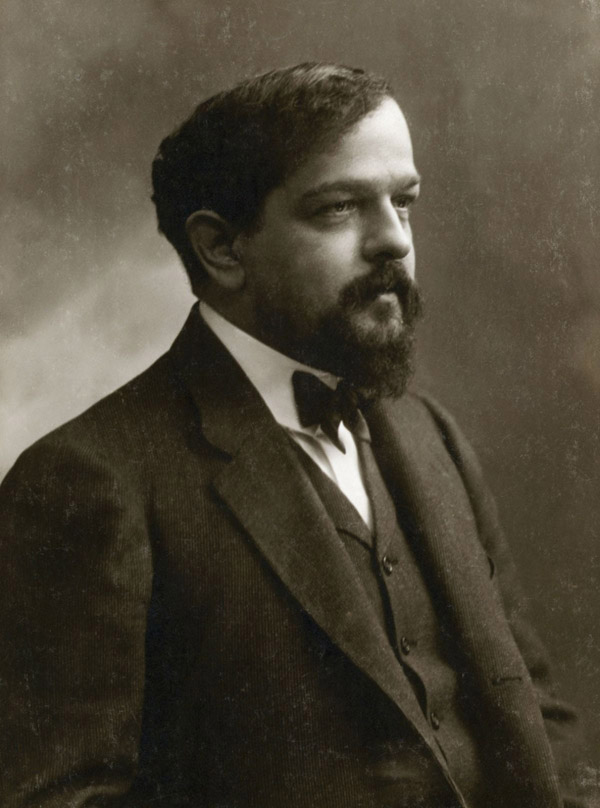
Claude Debussy was trained at the Paris Conservatoire and, although he was an extremely talented pianist, decided to pursue a career as a composer. His musical language extended the limits of harmony and form, with a remarkable command of delicate sound nuance, whether in piano writing or in the handling of a large orchestra. In his private life, he had to endure many trials, including financial struggles, social scandals, severe depression at the outbreak of World War I, and, from 1910 onward, a long battle with cancer, to which he finally succumbed in Paris on March 25, 1918 during one of the WWI German bombing campaigns.
Debussy's main interest was the sensuous quality of music, which led him to develop a uniquely French musical style. He often referred to himself proudly as "Claude Debussy, musicien français (French musician)." Wagner's music was, nonetheless, a powerful influence on Debussy, even after he embraced the "French music" banner against the ponderous Germanic musical tradition. Wagner's influence notwithstanding, Debussy always remained a remarkably independent artist; as a music journalist writing under the pseudonym of "Monsieur Croche" (Mr. Quarter Note), he fiercely opposed all worship of past composers.
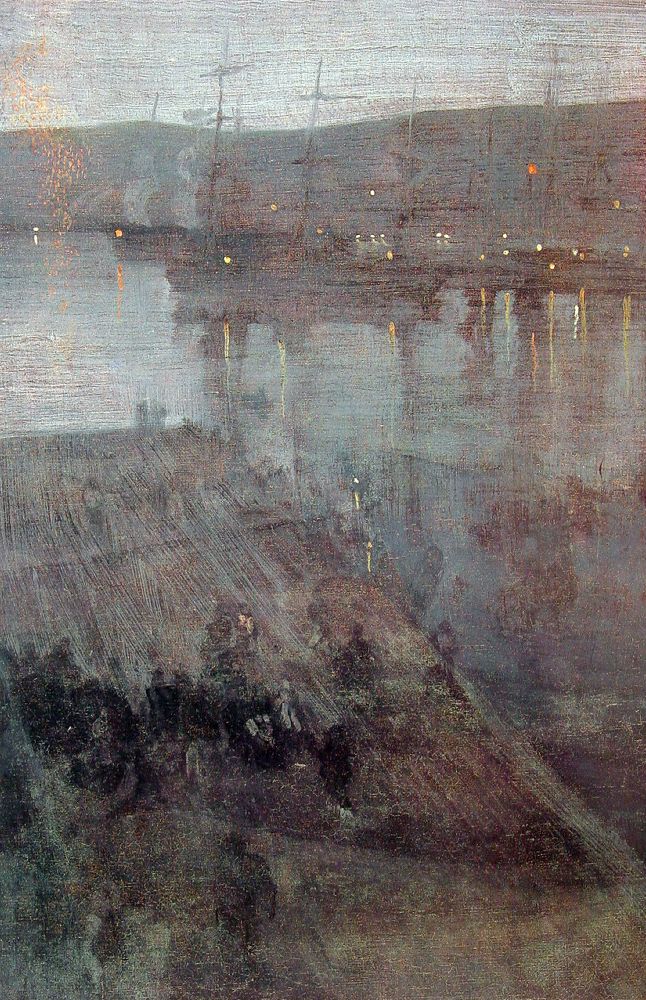
Debussy was interested in the colors and sonorities that chords produce in their own right rather than the traditional role of the chord as an element in a continuous harmonic progression leading to a tonal resting point. This hazy, sensuous, color-based musical approach led to his reputation as an impressionist composer—a label he despised—as his music seemed to have parallels with impressionist paintings from the 1870s and 1880s by artists including Claude Monet, Edouard Manet, Camille Pisarro, and Pierre-Auguste Renoir. Debussy acknowledged the influence of the American painter James McNeill Whistler (1834–1903), who lived in France for a while. Whistler gave many of his works musical names, such as Harmony in Blue and Silver, and Nocturne in Blue and Gold, and it was after Whistler's nocturnes, not those of Chopin, that Debussy named his own Three Nocturnes.
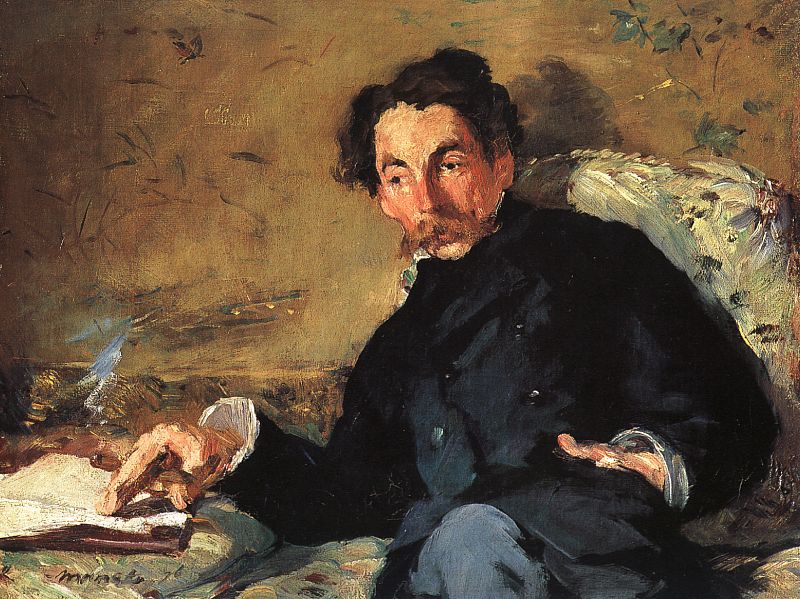
The main literary influence on Debussy was symbolism, in particular the work of Paul Verlaine and Stéphane Mallarmé. Debussy wrote a number of songs using texts by Verlaine. Mallarmé's best-known poem, L'après-midi d'un faune (The Afternoon of a Faun), published in 1876, depicts a faun—a mythological creature that was half goat and half man—as he awakens in the sunlit woods recalling a dreamlike vision of passionate sensuality. In his Prélude à l'après-midi d'un faune (Prelude to the Afternoon of a Faun; 1894), Debussy mirrors the mood and outline of the poem through a rich palette of orchestral color that gives the impression of sounds floating in the air rather than being rooted in a home key.
Composer: Claude Debussy
-
"Préludes, Book 1, L. 117: No. 10: La cathedrale engloutie"
Debussy gave many of his works evocative, impressionistic titles whose purpose was not to convey a specific program but rather to suggest a mood associated with an image or sensation. In his two books of twelve Preludes, Debussy appended each suggested title (for example, "...Sounds and Perfumes Turn in the Night Air," "The Girl with the Flaxen Hair") at the end of the printed score, rather than at the top.
Follow the Listening Guide as you listen to "La cathédrale engloutie" (The Sunken Cathedral; 1910), from his first book of Preludes (his second book was published in 1913).
Composer: Claude Debussy
-
"Prélude à l'après-midi d'un faune"
In his own words...
"I wish to write down my musical dreams in a spirit of utter self-detachment. I wish to sing my interior visions with the naive candour of a child."
Claude Debussy
In 1889, greatly impressed by Javanese Gamelan music at the Universal Exhibition in Paris, Debussy started looking for alternatives to the major and minor scales of traditional harmony by experimenting with harmonically ambiguous structures such as the whole tone and the pentatonic scales. Many of the melodies in his 1905 orchestral masterpiece La Mer (The Sea) were based on the pentatonic scale.
Composer: Claude Debussy
-
"La Mer: Jeux de vagues"
Piano works such "Dans le mouvement d'une Sarabande" from Images Oubliées used whole-tone scales, parallel 9th chords, and pentatonic scales.
Composer: Claude Debussy
-
"Images oubliees, No. 2: Dans le mouvement d'une Sarabande" [ 00:36-00:42 ]00:06
Standing at the border between late 19th-century Romanticism and early 20th-century musical experimentation and innovation, Debussy was the leader of the French musical avant-garde, exerting a powerful influence on his contemporaries and on future generations of composers worldwide, including such important figures as Igor Stravinsky, Olivier Messiaen, Pierre Boulez, Steve Reich, John Cage, and Toru Takemitsu, as well as many important jazz figures such as Duke Ellington, Antonio Carlos Jobim, and Bill Evans.
In his own words...
"Any sounds in any combination and in any succession are henceforth free to be used in a musical continuity."
Claude Debussy, as quoted in Silence (1961) by John Cage