
Overview
Chicago jazz musicians continued to gravitate to New York, owing largely to the sheer magnitude of the Big Apple and the opportunities it presented. In this lesson, we will learn more about important musicians, their performing talents, and members of the orchestras they established.
In the 1920s and 1930s, Chicago and New York were not the only cities where jazz was emerging and evolving. Its rapid spread meant that nearly every metropolitan area in the United States had its own burgeoning jazz scene.
There were, however, a few cities where jazz was particularly nurtured and performance opportunities were more abundant than in others. In this section we will see how Kansas City was one of those cities, possibly the only one that could rival New York and Chicago in the early 1930s, and look at the early careers of Count Basie, Duke Ellington, and Mary Lou Williams, three musicians who displayed enormous gifts as instrumentalists, bandleaders, composers, and arrangers.
Objectives
Upon completion of this lesson, you will be able to do the following:
- Appreciate Benny Goodman’s contribution to the popularization of swing music in America
- Recognize Kansas City's importance as a center for jazz during the swing era
- Identify musicians associated with Count Basie and their contributions to jazz
- Identify Count Basie's use of call and response in his band's arrangements
- Define riff
- Define head arrangement
- Recognize the contributions to jazz of Mary Lou Williams
- Recognize the contributions of Billie Holiday and Ella Fitzgerald to vocal jazz and popular song
Count Basie
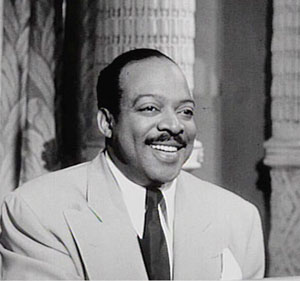
Of all the notables to come to prominence in "KayCee," no one is so universally admired as Count Basie. Pianist and bandleader, Basie developed a more relaxed, swinging style of jazz by paring down the Fletcher Henderson style. Basie's style featured more solos, as well as more short-riff call-and-response between the reeds and brass. More than anyone else, Basie popularized this Kansas City style of swing.
William "Count" Basie (1904-1984) grew up in Red Bank, New Jersey, and from an early age he learned piano from his mother. While still in his teens, he made his way to Harlem to learn from such masters of stride piano as James P. Johnson and Fats Waller.
For several years Basie performed in and around New York, and he also toured as a solo pianist and accompanist for blues singers on the vaudeville circuits. That's how Basie found himself stranded in Kansas City in 1927. He found work there playing piano for silent movies and, within a year, was invited to join Walter Page's Blue Devils. The following year he became a member of Benny Moten's Kansas City Orchestra.
After Moten died suddenly in 1935, Basie organized a group of his own called the Barons of Rhythm, which included many of his band mates from Moten's orchestra. He landed an engagement at the Reno Club, one of KayCee's most popular nightspots. This gig soon brought his band to the attention of New York booking and recording agents. Within a year's time, the Count Basie Orchestra was playing at the Roseland Ballroom in New York and beginning a long and successful recording career that would elevate his orchestra to the top tier of big band orchestras nationwide.



Billie Holiday's song God Bless the Child inspired a children's picture book of the same name , which was published by Harper Collins in 2004.
