
Overview
In this section, we will focus on the late 1950s and early 1960s to learn more about Miles Davis and two of his most influential sidemen: Bill Evans and John Coltrane. We will consider the significance of Davis' musical compositions and those of his fellow musicians, and examine how their works continue to impact jazz even to the present day.
Objectives
Upon completion of this lesson, you will be able to do the following:
- Identify many of the contributions of Miles Davis to jazz
- Define modal jazz
- Recognize the contributions of Bill Evans to jazz—most especially to jazz piano
- Recognize the contributions of the members of Bill Evans’ most celebrated trio
- Recognize the contributions of John Coltrane as saxophonist, composer and bandleader
- Recognize the contributions of the members of John Coltrane’s classic quartet
Flamenco Sketches
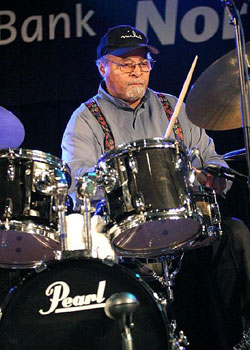
The brilliance of Kind of Blue ♫ shines on every track. Three are medium-tempo pieces, and two are played at a very slow, ballad -like tempo — less than one beat per second. These slow pieces, Flamenco Sketches ♫ and Blue in Green ♫, are for many listeners the most exquisite jewels of the album. Each presents a cyclical progression of chords — and modes — that showcases not only the improvisatory talents of the individual soloists, but also the extraordinary rhythm sectionThe section of a jazz combo consisting of piano, guitar, double bass, and drums. . It's not easy to play jazz at this tempo and cohere. Bill Evans, Paul Chambers, and Jimmy Cobb are superb, providing the support and forward motion essential to this relaxed, understated musical style.
Flamenco Sketches ♫ is a piece without a melody. Instead, it's based on a series of five different modesA type of musical scale. . Davis instructed his soloists to play in each mode for however long they wanted, and then to move to the next mode in the series.
Needless to say, this required an extraordinary level of communication between the soloist and the rhythm section players. Interestingly, given all this freedom, each of the soloists nevertheless chooses rather standard four-and eight-measure lengths for each modal segment. The musical result, though, is fresh and sublime. We hear solos from Davis, Coltrane, Adderley, Evans, and Davis. Let's listen Flamenco Sketches ♫.
Let's consider Davis' solo in more detail to track the modal changes that are essential to the piece. We have previously examined the Dorian mode, and that mode plays a part in this piece as well. But we have other modes based on the same seven-note scale, depending on where you start. For example, using just the letter-name notes, E to E is the Phrygian mode; F to F is the Lydian mode; and G to G is the Mixolydian mode. You don't have to memorize these modes for this class, but being familiar with them will help you hear and appreciate the modal changes.
After a four-bar introduction (0:00-0:18), Miles begins his solo with muted trumpet in the opening key of C major (also known as the Ionian mode). This is one of the slowest and most luxurious pieces in the history of jazz, and Miles sets the tone with long sustained notes. Four bars later the band shifts to E-flat Dorian, and Miles continues his improvisation in that mode for the next four bars (0:36-0:52). The next four bars are played in B-flat Ionian (0:53-1:10), followed by eight bars in the Spanish-flavored D Phrygian mode (1:10-1:44). The last of the five modes is G Dorian, and Miles wraps up his solo over these four bars (1:44-2:02).



The Village Vanguard is one of New York's celebrated jazz rooms, opened in 1935 by Max Gordon
