
Overview:
Most music is created with a key or pitch center; a group of pitches based on a scale in which each pitch has a corresponding chord that in turn, have a unique relationship within the grouping. A key signature contains accidentals (sharps and flats) as a short-hand method of indicating which pitches require the accidentals so that they don’t need to be written throughout the entire composition. The pitch center or scale gives a music composition a sense of stability and cohesiveness through melodic and harmonic progressions of tension and release.
Objectives:
Students will be able to:
- Identify the basic major scale patterns.
- Identify how the scales relate to the key of a music composition.
- Define the meaning of transposition, key, and scale.
- Identify the purpose of meter in musical composition.
- Define how changes in note beams and ties alter duration within the phrase.
- Define the musical term anacrusis.
Dotted Notes
The rhythmic value of any note can be lengthened by using a dot and/or a tie. A dot placed to the right of a note head or a rest increases its value by a half of its own duration. A dot can be added to any note or any rest.
The following table summarizes the most common dotted note names and their symbols including the ones that represent rests. Rests indicate periods of silence during which no notes are played or sung.
| Note Name | Symbol and Equivalent Value | Equivalent Rest |
|---|---|---|
| Dotted Half |
  |
 |
| Dotted Quarter |
  |
 |
| Dotted Eighth |
  |
 |
| Dotted Sixteenth |
  |
 |
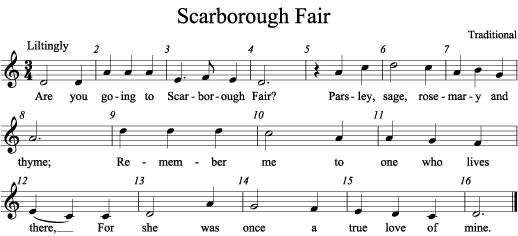
“Scarborough Fair,” a well-known traditional song, uses a dotted quarter note in measure 3 and dotted half notes in measures 4, 8, and 16. In this short, sixteen-measure song, each measure contains three quarter notes or its equivalent in other note values. Measure 1, for example, contains one half note and one quarter note; measure 3 contains one dotted quarter note, one eighth note, and one quarter note; and measure 16 contains only a dotted half note.
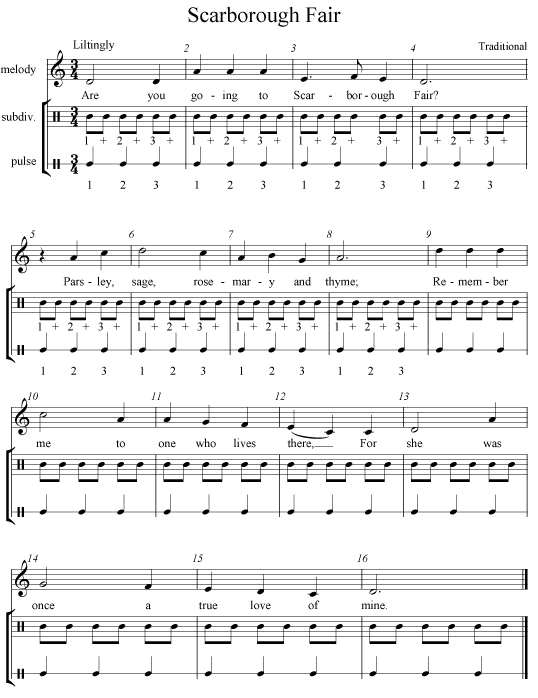
The underlying pulse of three quarter notes per measure in “Scarborough Fair” can be indicated by a row of quarter notes in the bottom rhythm line in the score below (pulse). A second line can be added immediately above (subdiv.) to indicate the subdivision of the beat into eighth notes—each quarter note equals two eighth notes. Above these two rhythmic lines, the melody progresses with the tempo and combination of note values that give it its unique character.
Try counting the main beat and the subdivision of the beat as you listen to the melody. To count the beats, say ONE, TWO, THREE with each quarter note in the pulse line. To count the subdivision of the beat, say ONE and TWO and THREE and (+ = and) in synch with the eighth notes for each measure. Use the Scorch™ tempo control to slow down the speed of the music if necessary.
Notice that the dotted quarter note in m.3 equals three eighth notes in the subdivision line (the syllable bor of Scar-bor-ough corresponding to the + of the second beat), and that the dotted half note in m. 4 (D4) equals three quarter notes in the pulse line, and six eighth notes in the subdivision line.
Now, try playing “Scarborough Fair” on the keyboard.