
Overview
Despite their apparent stylistic diversity, different jazz pieces share common elements, such as improvisation and swing feeling, and on a more basic level, common forms and instrumentation. This section’s focus on form and timbre in jazz will hopefully give you a deeper understanding of jazz improvisation. To fully appreciate jazz improvisation, you should be familiar with the standard jazz forms, the sound of various instruments and their role in an ensemble—whether a musician is playing written parts or improvising.
This section also looks at the various cultures that contributed to the early development of jazz’s distinctive style and flavor. Learning where and how jazz was first created will help you understand it better.
Objectives
Upon completion of this part of the lesson, you will be able to do the following:
- Recognize the standard forms of jazz.
- Understand the roles of the various jazz instruments.
- Identify the sounds of these instruments.
- Identify the cultural origins of jazz.
- Identify the musical contribution of brass bands to jazz.
- Identify the significance of ragtime music.
- Identify the blues as a musical style.
- Identify some call-and-response genres that predate jazz.
- Identify New Orleans as a fertile culture that “birthed” jazz.
Drums
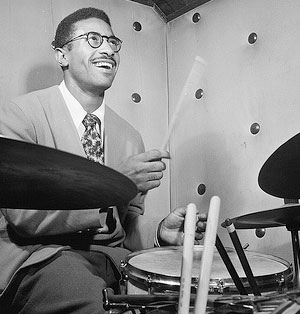
The drummer is both the timekeeper and the creator of bountiful syncopations and polyrhythms that add rhythmic color to a performance. With four limbs at work on four drums, two cymbals, and a high-hat — the standard "set of traps" — the drummer is at once he most primal, intricate, and versatile performer of the combo.
Let's go through each of the drummer's limbs, starting with the feet.
The drummer's left foot is devoted to the hi-hatA type of cymbal used in drumming, consisting of two cymbals mounted on a stand, one on top of the other., also known as the sock cymbal. It's actually two cymbals mounted together on a vertical rod, with a pedal mechanism operated by the foot that brings the two cymbals together, allowing an alternating opening and closing of the high hat that creates its own distinctive "chick" sound.Since the modern jazz era, the high hat has frequently been used to create a backbeatA rhythmic accent on the weak beats in a measure, typically beats 2 and 4. — that is, an accent on the weak beats — by closing the high hat on every 2nd and 4th beat.
The right foot is on another pedal that operates a soft mallet that strikes the bass drum. In the modern jazz era, the tendency has been to strike the bass drum lightly, creating a soft, deep thud that may be used to mark the strong beats (1 and 3), or even to play on all four beats. Occasionally, the drummer creates an additional syncopation by striking the bass drum with greater force — what is referred to as a bombA drumming technique in which an additional syncopation is created by striking the bass drum with greater force. — that may be part of a rhythmic interaction with the soloist.
Drummers tend to use sticks in both hands. If they want a softer, lighter sound, they'll use brushes.
The left hand is, in many respects, the freest of the four limbs. The drummer will often play syncopated patterns with the left hand on the snare drum, or occasionally strike the small tom-tom on top of the bass drum. This left hand activity often contains kicks or prods that respond to the soloist and establish a rhythmic interaction.
The drummer's right hand is frequently devoted to the ride cymbal, playing ride rhythms Characteristic swing rhythms played by the drummer that may be described as "ching, chick-a-ching, chick-a-ching.”. These are the rhythms that lend such a strong "swing" to jazz, sometimes described with syllables such as "ching, chick-a-ching, chick-a-ching..." In addition to playing the ride cymbal, the right hand will often make its way to the large tom-tom to the right of the snare drum, adding punctuations or, during turnarounds, working with the other limbs to provide a fresh break from the repeated patterns.
A turnaround The last two bars of a phrase or chorus in which the standard rhythmic and melodic patterns are abandoned to allow a freer and more virtuosic expression by various instrumentalists, often drawing attention to the drummer. comes at the end of a phrase or chorus when the melody has come to repose, opening up room for additional rhythmic activity. It consists of two bars, or measures. For example, in a 12-bar chorus, it consists of measures 11-12. In a 32-bar form, there's typically a turnaround at the end of each 8-bar section (i.e., measures 7-8, 15-16, 23-24, and 31-32).
During the two bars of the turnaround, the steady rhythmic patterns established through most of the chorus are abandoned to allow various different featured activities among the musicians, even as the tempo is maintained.
In addition to his role within the rhythm section, the drummer also takes his occasional turns as a soloist. Because of the trap set's inability to convey either melody or harmony, lengthy drum solos are not as common. Often a drum solo is divided into solo passages of four or eight bars, alternating with the entire combo playing passages of the same length — which is known as trading fours A drum solo divided into passages of four bars in which the drummer alternates with the entire combo playing passages of the same length. or trading eightsA drum solo divided into passages of eight bars in which the drummer alternates with the entire combo playing passages of the same length.. (Similarly, a pair of soloists may alternate in the same fashion with one another or with the drummer, rather than having each solo for a complete chorus.)
Watch and listen now to drummer Mason Neely discuss the art of playing drums in a combo setting.



During the colonial period in North America, slaves' music-centered worship and gatherings were often banned for being too "idolotrous and wild" and had to be conducted in secret.
