
Overview
In the evolution of jazz, the New Orleans and Chicago styles of the 1920s gave way to the emerging swing style of the 1930s. In this, and the next several sections, we will learn about some of the most influential jazz musicians of this era and how their musical contributions helped shape the jazz style known as swing.
Objectives
Upon completion of this lesson, you will be able to do the following:
- Identify selected swing musicians and their contributions to jazz
- Define charts
- Identify the significance of call-and-response in Fletcher Henderson's compositions, as well as in others‘
- Define antiphonal counterpoint
Duke Ellington
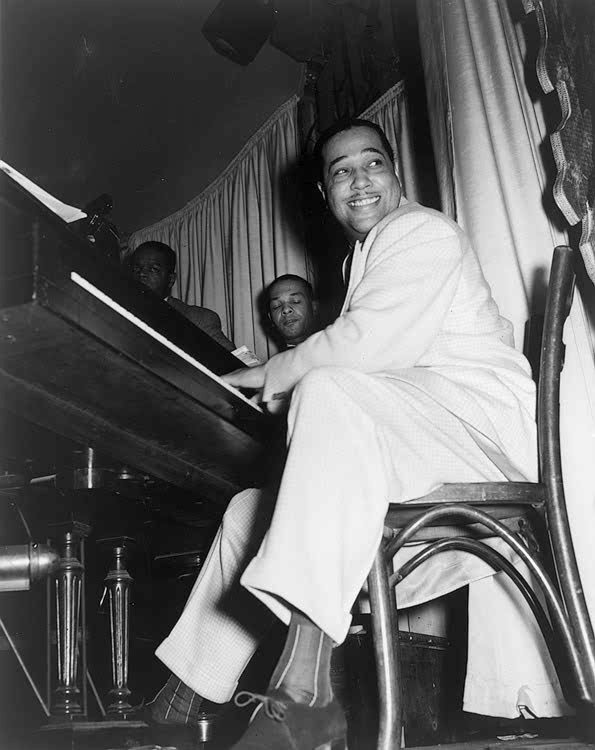
In this part of the lesson, we will learn about jazz's greatest composer, arranger, and bandleader, Duke Ellington, and several of his well-known sidemen. We will observe how Duke utilized the individual talents of his musicians to develop an orchestra unlike any other.
Fletcher Henderson had established the model that most swing bands emulated; that is, orchestrations that pitted the brasses against the reeds, and vice versa. There was one band, though, that did things differently, thanks to the compositional genius of its leader, Duke Ellington.
Duke Ellington (1899-1974) was the greatest composer of the swing era, and, many would say, the greatest composer in the history of jazz. Fittingly, among the considerable array of anointed jazz "royalty," perhaps none conducted himself with greater aristocratic bearing than the "Duke" himself.
Edward Kennedy "Duke" Ellington was born in Washington, DC and grew up there in modestly comfortable circumstances. His father was a butler for a successful medical doctor, and Ellington grew up in the doctor's home. His mother devoted herself to his upbringing, and from an early age, he was encouraged to believe that he was destined for greatness8.
Ellington's artistic inclination led him initially in the direction of visual arts, and for a time he considered becoming a commercial artist. But his love of music, along with the informal education in ragtime piano he was receiving at a local pool hall, set him on a different course. He became more serious about music as a profession, taking lessons in harmony and studying the piano rolls of James P. Johnson. By the early 1920s, Ellington had established himself in the Washington area as a pianist and bandleader. In 1923, he made his way to New York with a number of his sidemen9.
While success was far from immediate, Ellington persevered. From 1924 to 1927, engagements in downtown Manhattan at the Club Kentucky brought his band notice. Then, in 1927, Duke Ellington and His Orchestra began a four-year engagement at the Cotton Club in Harlem, arguably the center of the jazz world during those years.



"Duke Ellington wrote over 1,000 compositions in his lifetime as a Jazz band-leader, composer and pianist, including Jazz standards, film scores and classical works."
