
Overview
The history of jazz rightly begins in the city of New Orleans. In this section, we will learn about great New Orleans jazz musicians and their early recordings in Chicago. In the process, will also learn about the emerging Chicago jazz scene and some of the artists from that area who helped develop early jazz musical styles. Finally, we will do a short overview of early jazz in New York.
Objectives
Upon completion of this lesson, you will be able to do the following:
- Define collective improvisation
- Identify early jazz musicians and their contribution to jazz music
- Appreciate the significance of Dixieland jazz
- Recognize the impact Chicago had for musicians of early jazz
- Recognize the growing importance of New York for further developments in jazz
- Define chord substitutions
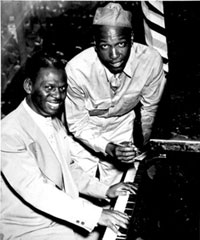
Earl Hines
Earl Hines (1903-1983) was an early jazz pianist from Pittsburgh who developed a horn-like styleA term used to describe the single-note melodic improvisations of pianists and guitarists imitating the style of horn players, since their instruments also allow them to play more than one note at a time. of improvisation that was highly influential. To refer to a style as "horn-like" is to focus attention on the right hand of the piano as it plays a single melodic line, much as a trumpet or saxophone would; that is, one note at a time. This style of playing may also be described as linearA term used to describe a single melodic line, whether played by a horn, piano, or guitar..
Hines moved to Chicago, and in 1928 he participated in a recording session with Louis Armstrong's Hot Five on the deservedly famous West End Blues ♫. The piece is a tour de force for Armstrong, but Hines also shines with his solo in the fourth chorus. We already listened to this piece earlier, but let's listen again as Louis Armstrong's Hot Five performs West End Blues ♫.
Louis Armstrong and His Hot Five, West End Blues ♫ (Joe Oliver and Clarence Williams), Chicago, June 28, 1928. Louis Armstrong, trumpet and vocals; Fred Robinson, trombone; Jimmy Strong, clarinet; Earl Hines, piano; Mancy Cara, banjo; Zutty Singleton, drums.



Louis Armstrong was cast in the 1936 film Pennies from Heaven, starring Bing Crosby. This led to frequent appearances in TV and film, adding to his fame.
