
Learning Objectives
- Outline the social, cultural, and political impact of WWI and WWII.
- Discuss the growth of the United States as a world power.
- Describe the impact of technological advancements on the development of music in the twentieth century.
- Describe, compare and contrast the main stylistic differences of Contemporary music styles including impressionism, post-Romanticism, serialism, and expressionism.
- Summarize the changing nature and application of the concept of tonality throughout the century.
- Discuss the impact of Claude Debussy's "Prelude to the Afternoon of a Faun" in light of the Symbolist movement in literature.
- Illustrate how the Russian composer Igor Stravinsky experimented with rhythm, new instrumental combinations, and the percussive use of dissonance, and discuss the impactof these techniques on contemporary music.
- Describe the impact of Arnold Schoenberg and the Second Viennese School on 20th-century music.
- Distinguish the main stylistic differences of nineteenth- and twentieth-century composers and styles.
- Describe the musical and political impact of “national schools” of composition that developed across Europe during the 20th century.
- Explain the impact of composer Aaron Copland on American contemporary music.
- Describe the impact of Latin American composers on the larger "art music" scene and repertoire.
- Define and analyze the main differences between jazz, ragtime, and blues.
Music of the 20th and 21st Centuries (1900-Present)
Music of Modern Europe: Electronic Music and Other Trends
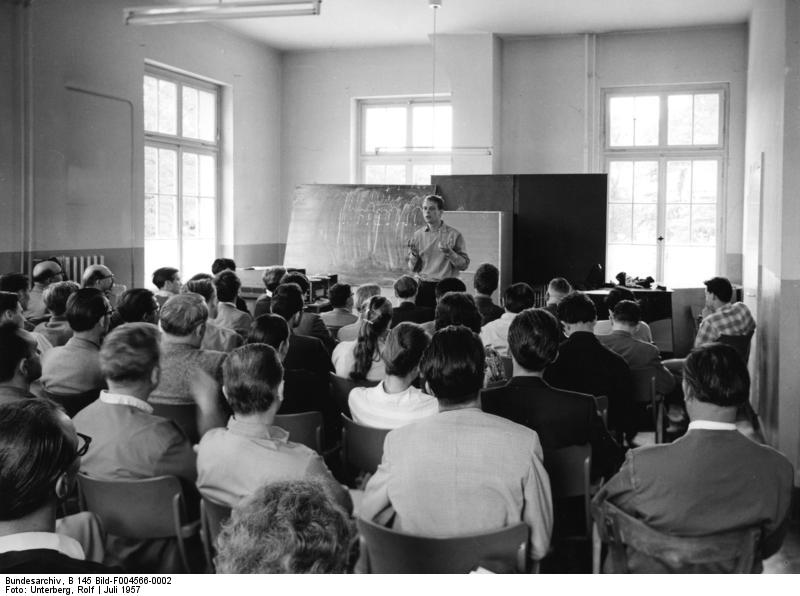
Closer to mid-century, modernism branched into several revolutionary (avant-garde) aesthetical and philosophical trends. Much of this revolutionary new activity was centered in the German town of Darmstadt, where a summer school for new music was set up in 1946 with the aim of reinvigorating the musical creativity that had been stifled by the Nazi regime for so many years. A further aim was to create works that didn't subscribe to any particular national school of thought. Influenced by the work of Arnold Schoenberg, Anton Webern, Olivier Messiaen (1908-1992), and Edgard Varèse, and propelled forward by courses led by Pierre Boulez (b. 1925), Karlheinz Stockhausen (1928-2007), and Luigi Nono (1924-1990), the school quickly became the international center for the avant-garde during the 1950s.
The two most important developments of the Darmstadt School centered on a new compositional technique called total serialism and on the use of electronic music. Total serialism extended the principles of Schoenberg's serialism to all other aspects of music other than just pitch. That is, as well as having a tone row of twelve pitches, there could be rows for rhythm, dynamics (loudness or softness), and articulation (the manner in which notes are played—smoothly or detachedly, for instance).
Electronic music was the other trailblazing component of avant-garde music. New technological developments in the post-World War II era led to the creation of new electronic instruments and recording devices. Soon, creating and editing music with these new tools became a medium in itself. Electronic composers manipulated musical sounds and noises, first with tape recording and later by purely electronic means. Thus, the term "electronic music" may refer to:
- Tape sounds produced by natural sources of any kind—voices, laughter, a car, footsteps, sounds from nature—that have been electronically manipulated and combined to form a sound collage.
- Music made up of sounds that have been created by purely electronic means.
Electronic music composed in the first sense above is also called musique concrète (concrete music), a term coined by a group of early electronic music experimenters working in the 1940s under the leadership of the French composer Pierre Schaffer at the Experimental Studio of the French National Radio. The term "concrete" denotes the technique of composing with natural (concrete) sound sources on tape as opposed to abstract musical notation.
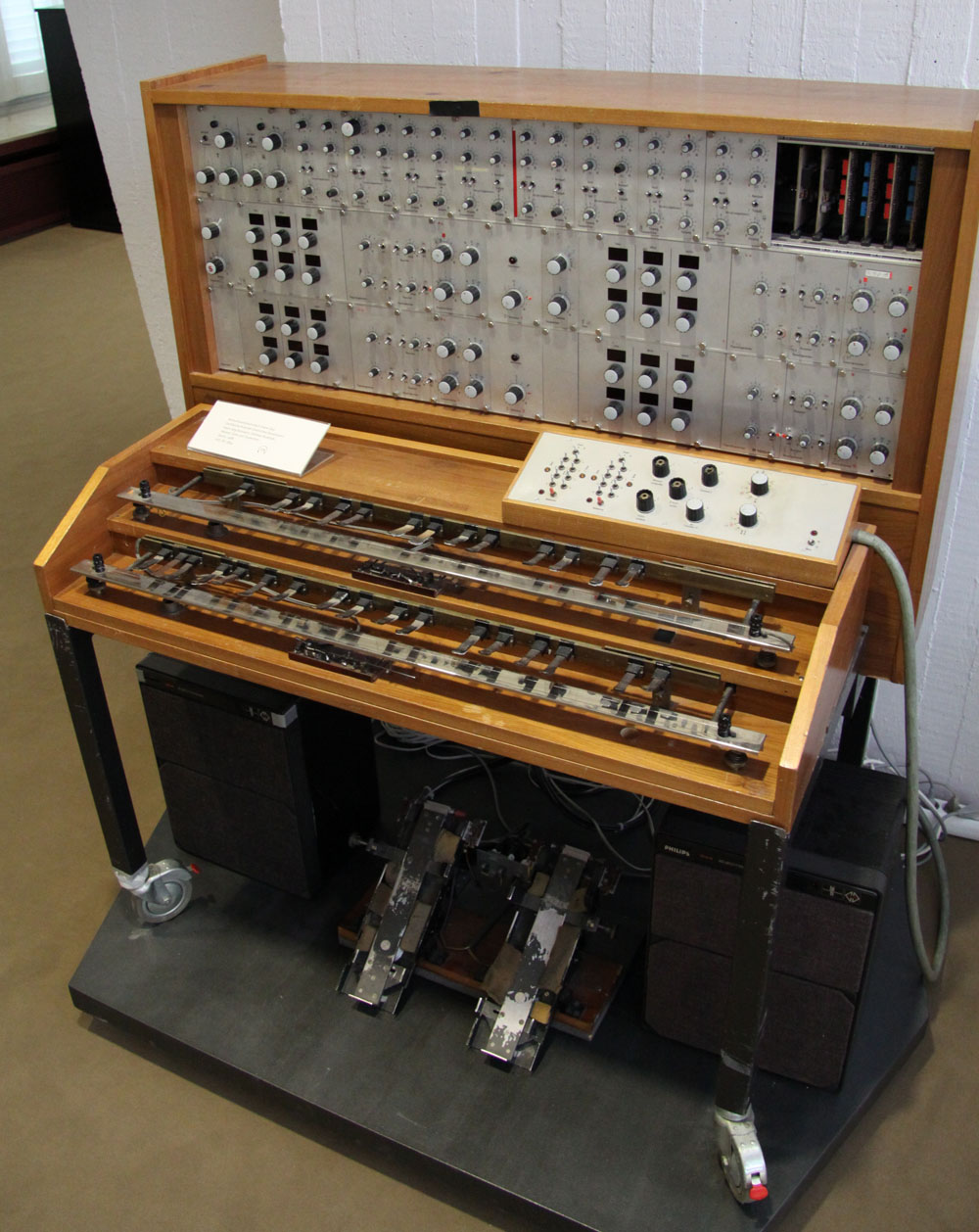
Mixtur-Trautonium
Based on the original trautonium, the composer/performer Oskar Sala developed the Mixtur-Trautonium, which allowed for the production of sounds and tunings that had been known only in theory since the Middle Ages. Sala created many of the sound effects for Alfred’s Hitchcock’s suspense film The Birds (1963).
Electronic instruments were not an entirely new phenomenon in the 1950s. During the 20s and 30s, new instruments had been developed, including the ondes Martenot (invented by the French cellist Maurice Martenot in 1928 and used famously by Olivier Messiaen in his gargantuan Turangalîla-Symphonie), the theremin (invented by Leo Theremin in 1920), the Hammond Organ (patented by Laurens Hammond in 1934 and based on Thaddeus Cahill's Telharmonium of 1897), and the trautonium (developed by Friedrich Trautwein in 1930).
As technology redefined musical sound, composers looked for other ways to define sound itself. Everyday noises were incorporated into compositions; sometimes, everyday noises even became compositions. In the 1950s, some composers introduced an element of chance, creating what is known as aleatory music (from the Latin alea meaning "dice"). Music of Africa and Asia penetrated deeper into Western musical consciousness, resulting in completely different ways of thinking about musical structure. Another major development was minimalism, which makes use of small repeating motives and static harmonies over long periods of time, resulting in music with very gradual changes.
Composer: Olivier Messiaen
-
"Turangalîla-symphonie: I. Introduction"