
Overview
The history of jazz rightly begins in the city of New Orleans. In this section, we will learn about great New Orleans jazz musicians and their early recordings in Chicago. In the process, will also learn about the emerging Chicago jazz scene and some of the artists from that area who helped develop early jazz musical styles. Finally, we will do a short overview of early jazz in New York.
Objectives
Upon completion of this lesson, you will be able to do the following:
- Define collective improvisation
- Identify early jazz musicians and their contribution to jazz music
- Appreciate the significance of Dixieland jazz
- Recognize the impact Chicago had for musicians of early jazz
- Recognize the growing importance of New York for further developments in jazz
- Define chord substitutions
Fats Waller
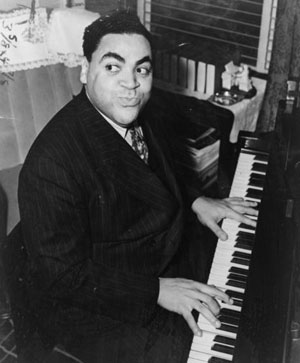
James P. Johnson's prize student, Thomas "Fats" Waller (1904-1943), took the stride style he learned and infused his original piano pieces with rich textures, vigor, and an irrepressible joy. Waller was well known for his showmanship and comedic delivery. His show tunes, such as Ain't Misbehavin' ♫, were enormously popular. However, Waller's stride style piano pieces are regarded as his greatest contributions to jazz. Let's listen to one of these, Handful of Keys ♫, recorded in New York on March 1, 1929.
Following a playful 8-bar introduction, we hear Waller's tune, a 32-bar AABA song form that he takes at a very brisk tempo (0:10-0:40). In the second chorus, Waller repeats his melody an octave higher (0:40-1:10). Then follows a 4-bar insertion, by which he changes keys from F major to B-flat major.
The next 32-bar chorus is not the tune we have just heard, but a new tune that is a binary form (AA') with two similar 16-bar sections (1:14-1:45). For the two remaining choruses, Waller returns to his original tune in the original key, adding more and more embellishments that serve to highlight not only his mastery of stride style piano, but his improvisational brilliance as well.



