
Objectives
- Relate how Romantic poets and artists abandoned traditional subjects, turning instead to the passionate and the fanciful.
- Relate how the Industrial Revolution impacted the technological development and affordability of musical instruments.
- Analyze how the orchestra grew in size and sound as new instruments were introduced and composers demanded greater levels of expression.
- Illustrate how Romantic composers explored nationalistic folklore and exotic subjects.
- Identify the form of romantic period songs, including strophic, through-composed, and the modified strophic forms.
- Examine the German art song (or Lied) as a favored romantic period genre.
- Discuss how the music of Franz Schubert impacted romantic period music.
- Discuss how the music of Frédéric Chopin impacted romantic period music.
- Trace the ascendance of program music in relation to absolute music.
- Summarize how political unrest throughout Europe stimulated the formation of schools of musical nationalism in Russia, Scandinavia, Spain, England, and Bohemia among other countries.
- Differentiate between the distinct national styles of romantic opera in France, Germany, and Italy.
- Discuss how the Italian nationalist composer Giuseppe Verdi impacted romantic period music.
- Trace how choral music became a popular artistic outlet for the middle classes.
- Discuss how the Russian composer Pyotr Ilyich Tchaikovsky impacted romantic period musi
Romantic Period: Felix Mendelssohn
Felix Mendelssohn
Mendelssohn and his sister Fanny grew up in a home surrounded by intellectuals. Their grandfather, Moses Mendelssohn, was a well-known Jewish philosopher. The model for G. E. Lessing's Nathan the Wise, Moses was admired as the epitome of tolerance in a generally intolerant world. In 1812, after the French occupation of Hamburg, the family moved to Berlin. In Berlin, Mendelssohn studied music with Carl Zelter who regarded the boy as a second Mozart. As a child Mendelssohn was charming and precocious; he profited from the wide cultural interests of his parents and relations, excelled as a pianist, and was busy with composition after composition. In 1816, he was baptized a Christian, a step taken by his father, Abraham Mendelssohn, six years later. In this action, the family accepted what Heine described as “a ticket to admission into European culture,” although, by prejudiced contemporaries, it was not always regarded as valid. This religious conflict was common, as Jews were often not considered equal members of European society. (For a similar case study, see the life of Gustav Mahler).
When it came to his son's career, Abraham Mendelssohn sought the best advice. In 1825, Cherubini, director of the Paris Conservatory, was consulted and agreed that Felix should become a professional musician. That same year, Mendelssohn started to meet the most distinguished composers and performers of the day. His career, however, took shape in Berlin, with prolific activity as a pianist, composer, and conductor. His education, nonetheless, also included a period of travel throughout Europe, a Grand Tour that took him as far north as Scotland, and as far south as Naples. These journeys served as inspiration for many of his compositions.
Though Mendelssohn revered the music of Beethoven and Mozart, he also cherished the music of Bach. In the early 19th century, some of Bach’s music was known, but most of his works had not received popular recognition. At an early age, Mendelssohn decided to raise awareness about one of his favorite composers. Therefore, in 1829, he arranged a performance of the St. Matthew Passion, a work that had been relatively unknown since Bach’s death. The performance spurred a renewed interest in the artist’s music, leading to the formation of the Bach Society for the cataloging and preservation of his music in 1850.
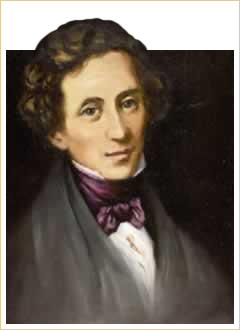
In 1835, Mendelssohn was appointed conductor of the Leipzig Gewandhaus Orchestra. There were concurrent commitments to be fulfilled in what became a short career of breathtakingly intense activity. In Leipzig, he established a series of historical concerts, continuing the revival of earlier music on which he had embarked under Zelter with the performance of the St. Matthew Passion in 1829. Mendelssohn’s admiration for Bach may be heard in his choral music. The polyphonic texture of his choral works such as St. Paul, Elijah, and Hear My Prayer, imitates Bach’s choral treatment in his cantatas and passions. Mendelssohn and Brahms, the two 19th century composers who best understood choral writing, also were the most knowledgeable about 17th and 18th century music. Furthermore, they were also the most resistant to the extreme tendencies of the Romantic era.
Composer: Felix Mendelssohn
-
"Hear My Prayer"
At the same time, however, Mendelssohn encouraged contemporary composers, even those for whom he felt little sympathy. In 1843, he established the Leipzig Conservatory. At the age of 38, on November 4, 1847, six months after the death of his beloved sister Fanny, Mendelssohn died.
Mendelssohn’s symphonies adhere fairly strictly to classical form and scope, particularly compared to the more effusive works of some of his contemporaries such as Hector Berlioz. It is precisely this simplistic element of Mendelssohn’s music that makes him a Classicist at heart. There is, however, a Romantic sparkle in his instrumental works that places him among the transitional composers.

As a child Mendelssohn was charming and precocious; he profited from the wide cultural interests of his parents and relations, excelled as a pianist, and was busy with composition after composition...

Mendelssohn's Works
Orchestral Music
Between the ages of 12 and 14, while still a child, Mendelssohn wrote 13 string symphonies. In what must pass for compositional maturity, from the age of 15 onwards, he wrote five more symphonies for full orchestra. The Symphony No. 3 in A minor, Op 56 was the second in conception and the last in order of completion. Its inspiration came from a visit to Scotland in 1829, but was not finished until 1842 and, in Leipzig that same year, was given its first performance. The Italian Symphony was completed in 1831 but, due to his own dissatisfaction with it and his intention of revising the first movement, remained unpublished in Mendelssohn's lifetime. He developed the ideas for the symphony during his stay in Italy in 1831. In both works, Mendelssohn relies on regional dance rhythms to accurately depict the landscape in musical terms. For example, the second movement of the Scottish Symphony is built on the bright rhythmic pattern and pipe sounds reminiscent of a Scottish country dance. The final movement of the Italian Symphony is based on two traditional Italian dances, the saltarello and the Neapolitan tarantella. The Symphony No. 5, Reformation, written in 1832 to celebrate the third centenary of the Augsburg Confession, and the Symphony No. 2, the choral Lobgesang, written to mark the fourth centenary of the invention of printing in 1840, are performed less frequently.
In the orchestral works that are not symphonies, Mendelssohn operates as a true Romantic artist. The concert overture is a single-movement work designed to be a short attention grabber at the beginning of a concert. The overture Ruy Blas, completed in 1839, is based on the play by Victor Hugo. One of the greatest early examples of a concert overture is Mendelssohn’s Hebrides Overture also known as Fingal’s Cave, based on a poem by Goethe, a writer who had received the young Mendelssohn at Weimar and prophesied a successful career for him. Inspired by the composer’s travels, the work evokes a visit to Scotland and the sight of the sea surging over the Giant's Causeway. This piece is remarkable for its orchestral representation of the ocean.
Audiences in the Romantic era were fascinated with program music, music that tells a story or paints a musical picture. The four main types of program music in the Romantic era were: the symphonic poem, the program symphony, the concert overture, and incidental music. The symphonic poem, a single-movement work that tells a story, is most frequently found in the music of the late-Romantic period. Two examples that we will listen to are Franz Liszt’s Hamlet and Richard Strauss’ Don Quixote. The program symphony is a multiple-movement symphony with a program. One of the best examples of a program symphony is a work by Berlioz that we will listen to in an upcoming chapter, the Symphonie Fantastique.
Composers wrote incidental music to be performed during a play. Its modern equivalent is music for film. Perhaps the greatest example of incidental music is Mendelssohn’s music for Shakespeare’s play Midsummer Night’s Dream, written when the composer was only 17-years-old. The Scherzo evokes a delightful world of fairies and nymphs. In works such as these, Mendelssohn comes closer to the ideals of the Romantic composers.
Composer: Felix Mendelssohn
-
"Symphony No. 3 in A minor, Scottish: II. Vivace ma non troppo"
Composer: Felix Mendelssohn
-
"Symphony No. 4 in A major, Op. 90, Italian: IV. Saltarello: Presto"
Composer: Felix Mendelssohn
-
"The Hebrides, Op. 26, "Fingal's Cave""
Composer: Felix Mendelssohn
-
"A Midsummer Night's Dream: Scherzo, Op. 61, No. 1"
The four main types of program music in the Romantic era were: the symphonic poem, the program symphony, the concert overture, and incidental music for a play...
Chamber Music
Mendelssohn wrote his first chamber pieces at the age of ten. One of his most delightful works is the Octet for double string quartet, which was written to celebrate the birthday of a violinist friend in 1825. His early precocity is also evident in the equally fine Sextet for violin, two violas, cello, double bass and piano, written in 1824. Mendelssohn also composed two string quintets, six string quartets, and two late piano trios. The two Cello Sonatas and the Variations Concertantes for cello and piano, along with a late Song without Words for cello and piano comprise an important part of 19th century cello repertoire.
Concertos
The best known of Mendelssohn's concertos is probably the Violin Concerto in E minor, written in 1844 and first performed in Leipzig the following year. He also wrote two piano concertos, the first written in 1831 and the second in 1837.
Piano Music
The 19th century was the age of the piano, a period in which the instrument became an essential item of household furniture and the center of domestic music making. Short piano pieces always found a ready market, but none were more successful than Mendelssohn's eight albums of Lieder ohne Worte (Songs without Words), a novel title that perfectly describes the length, quality, and intention of these short pieces.
Stage Works
Mendelssohn's music for the theater includes full incidental music for Shakespeare's A Midsummer Night's Dream, written for the new King of Prussia and first used at Potsdam in 1843, preceded by the Overture written in 1826. The music captures the enchanted fairy world of the play. In connection with the King's attempts to revive Greek tragedy, Mendelssohn also wrote incidental music for Antigone and Oedipus at Colonus by Sophocles, as well as for Racine's Athalie.



Each of Rachmaninoff's hands could span 12 piano keys, resulting in some extremely difficult piano compositions.
