





Fundamentals of Pitch
The Concept of Pitch
Let's begin with the official definition of pitch as given by The New Grove Dictionary of Music and Musicians:
Pitch: The particular quality of a sound (e.g. an individual musical note) that fixes its position in the scale.
Grove Dictionary of Music
This is a rather technical definition. Another way of describing it is this: The pitch of a sound is a person's relative perception of how high or low that sound is.
Frequency and Pitch
The precise pitch of a sound is determined by how many vibrations, or complete sound waves, happen every second. An example of this may be seen by observing the string of a guitar after it has been plucked. The back and forth movement of the string is a visible indication of the vibrations. The number of sound waves is called frequency, this is, the number of vibrations or cycles per second. The faster the frequency, the higher the pitch; the slower the frequency, the lower the pitch. The basic unit of frequency is the Hertz (one cycle per second), abbreviated Hz.
The frequencies an ear can hear are limited to a specific range of frequencies. The audible frequency range for humans is typically given as being between about 20 Hz and 20,000 Hz (20 kHz), though the high frequency limit usually reduces with age. Other species have different hearing ranges. For example, some dog breeds can perceive vibrations up to 60,000 Hz.
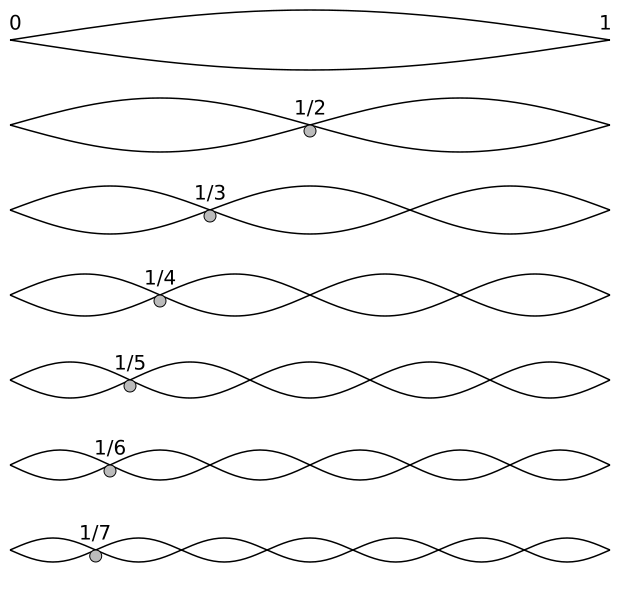
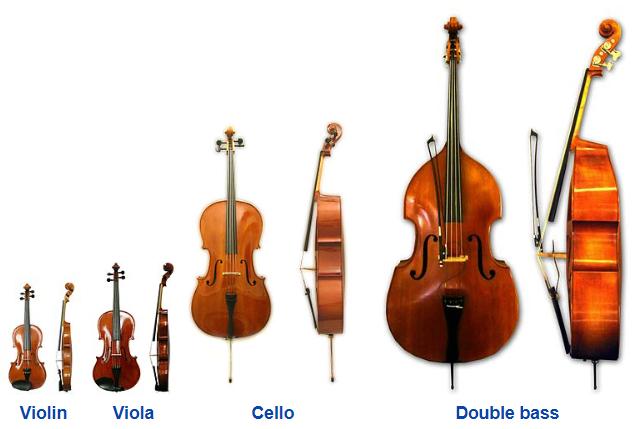
The characteristics of the string are also important. Imagine we have a string that, if plucked, produces a certain sound. If we make the string shorter, it will vibrate more quickly and will therefore produce a higher pitch (also called a tone). Conversely, if the string is longer, it will vibrate at a slower rate, and therefore the pitch will be lower.
As an illustration, the strings of a violin are shorter than those of the cello. In turn, the cello's strings are shorter than those of the double bass. Therefore, the strings of a violin vibrate more rapidly than those of both the cello and the double bass, thus producing higher pitches.
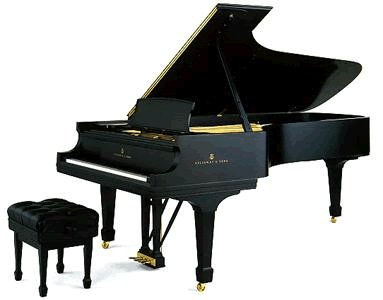
To the left is the familiar image of a grand piano. Each key of the piano represents a specific pitch that sounds when the hammer, activated by the press of a key, hits the string. Playing successive keys to the right produces slightly higher pitches. Naturally, it follows that playing successive keys to the left produces slightly lower pitches. Inside a grand piano, the strings connected to the keys get progressively longer and thicker toward the left. Longer and thicker strings vibrate more slowly and, therefore, produce lower pitches than shorter and thinner ones.
The keyboard is a combination of black and white keys. Note the pattern of two and three black keys grouped alternately. If this pattern were extended even further, the next set to the right would be a group of two black keys, and the next set to the left would be a group of three black keys after adding one more black key to complete a group of two.
Experiment with the virtual piano below, using your mouse to click successively higher pitches as you click keys to the right and successively lower ones as you click to the left. A full standard piano keyboard has a whopping 88 keys—52 white keys and 36 black keys—that, when depressed, produce pitches that span a wide range: seven and a quarter octaves from A0 (Frequency= 27 Hz) to C8 (Frequency = 4186 Hz).
It is important to understand that pitch is a relative concept. A person can only judge the highness or lowness of a sound by comparison to other sounds. Imagine playing one key in the middle of the keyboard above. If the keys to the right of that key are played, you would hear increasingly higher pitches—and to the left, increasingly lower ones—in relation to your starting pitch.
Just as variety in volume helps to sustain interest in a musical piece, the human ear seems to appreciate music that spans a variety of pitches throughout time. Many pieces of music use a consistently low pitch in certain passages contrasted against high pitches in others. Listen to "In the Hall of the Mountain King" by the Norwegian composer Edvard Grieg (1843–1907). In this piece, there is a clear contrast between sections that use low-pitched sounds and those where the composer has chosen to use high-pitched sounds.
Composer: Edvard Grieg
-
"Peer Gynt Suite No. 1, Op. 46: IV. In The Hall Of The Mountain King"
Low-pitched sounds
Composer: Edvard Grieg
-
"Peer Gynt Suite No. 1, Op. 46: IV. In The Hall Of The Mountain King" [ 00:03-00:20 ]00:17
High-pitched sounds
Composer: Edvard Grieg
-
"Peer Gynt Suite No. 1, Op. 46: IV. In The Hall Of The Mountain King" [ 01:26-01:34 ]00:08
Did you Know...
Our ears can't perceive the whole range of possible sounds. The low threshold—that is, the lowest sound that can be perceived—has a frequency of about 16 to 20 vibrations per second, or 16 to 20 Hz. The highest sound humans can hear vibrates at about 20,000 vibrations per second (Hz). This range, from 16 to 20,000 Hz, is called the audible frequency spectrum. Animals such as cats and bats can hear as high as 40,000 Hz. The lowest sound on a grand piano has a frequency of 27.5 Hz while the highest has a frequency of 4,100 Hz. The top pitch produced by the piccolo—a very small flute that is the highest-sounding instrument in a traditional symphony orchestra—has an approximate frequency of 4,186 Hz.
The middle pitch range (spanning 130–525 Hz) is the one most commonly used, and it is the one most satisfying to the ear over extended period of times. The extreme ends of the range, high and low, are often used for special emphasis or to produce unusual effects. The middle range also serves as the basis from which higher and lower sounds are explored. Some pieces of music contain little overall pitch variation. In fact, some pop songs may use only five or six different pitches, all of which remain in the same range. Other styles of music may change abruptly from one extreme to another, while others still feature smooth transitions between pitch levels.
People react to pitch in many different ways. However, if a listener is familiar with the style or tradition to which the music belongs, certain psychological reactions may come to be expected. In many types of music, high pitches tend to produce a feeling of lightness and energy, while low pitches evoke dark, mysterious feelings. Ascending pitches tend to produce tension; descending pitches may often create a feeling of calm and relaxation. Composers use these associations to good effect depending upon the type of emotion they wish to convey.
The Triumphal March and Chorus from the opera Aida by Italian composer Giuseppe Verdi (1813–1901) demonstrates how composers can achieve a dramatic increase of tension by raising the overall pitch of the music gradually. At the end of this example, there is a sense of “arrival” or resolution of the tension. Verdi achieves this resolution through the overall descent of pitch towards a point of calm or rest.
Composer: Giuseppe Verdi
-
"Aida: Act II: Triumphal March"
Dramatic increase in tension
Composer: Giuseppe Verdi
-
"Aida: Act II: Triumphal March" [ 00:27-00:51 ]00:24
Remember that many other factors including speed (tempo) and instrumentation (which instrument is being used) contribute significantly to the effect that music has on the listener. Nonetheless, pitch remains a critical component in determining the listener's perception of, and reaction to, music.