
Overview
Objectives
- Examine the relationship between music and the American civil rights movement during the 1960s
- Identify characteristics of Brown’s musical style from this period
- Identify some of the defining features and characteristics of funk music
- Recall the significance of Sly and the Family Stone in the development of funk music
- Examine the role George Clinton played in funk music during the 1970s with P-funk genre
- Examine how popular media such as Blaxploitation films and television programs helped promote African American music and musicians
Funk and the Media
The visibility of African Americans in music, film, and television continued to increase and improve during the 1970s. The Blaxploitation film genre was created by and for African Americans, and television shows such as Soul Train catered to African American viewers. These films and television programs had close relationships with music, and the music that accompanied them was an important part of the American musical soundtrack of the 1970s.
During the 1970s, a new genre of film called Blaxploitation emerged. Created largely outside the Hollywood establishment, films such as Sweet Sweetback’s Baadasssss Song (1971) showcased African American characters in urban situations.
Many of the films were action-oriented, featuring characters such as Foxy Brown, Sweet Sweetback, and Shaft, most of whom are as adept sexually as they are at fighting and solving crimes. Other times, characters in Blaxploitation films were searching for ways out of lives of drug dealing or poverty, such as Youngblood Priest, the lead character in Super Fly. The fact that these films were produced by and for African Americans made them unique at the time.
Many Blaxploitation films are indelibly linked to their soundtracks. For example, Earth, Wind, and Fire was practical unknown until they recorded the soundtrack for Sweet Sweetback’s Baaadasssss Song. Isaac Hayes’s soundtrack for Shaft (1971) popularized the sounds of Hayes’s slow, half-spoken delivery and the wah-wah pedal on the electric guitar. These characteristics can be heard in "The Theme from Shaft ♫," the album’s first single. Following Hayes’s lead, Curtis Mayfield wrote music for Super Fly (1972). Mayfield’s soundtrack includes the sounds of rock-influenced funk, such as the wah-wah pedal, but it also features lush strings and crisp production values. Recall that Mayfield had been writing and producing at Motown for nearly a decade, and his experience as a producer is evident in his film soundtrack. Tracks such as "Little Child Runnin’ Wild ♫" include the sounds of the orchestra as well as of the funk band and electric guitar.
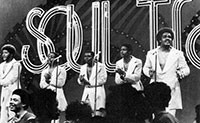
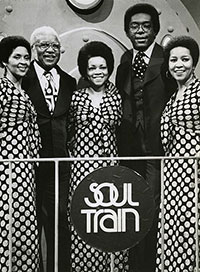
The television show Soul Train was another important avenue for increasing the visibility of African American music and culture. Soul Train ran from 1971 to 2006, and it is the longest running nationally syndicated program in the history of television. Hosted by disc jockey and news reader Don Cornelius, Soul Train appeared on Chicago’s WCIU until it was picked up for national distribution. Like Dick Clark’s American Bandstand, Soul Train featured popular bands and artists as well as plenty of dancing.
However, Soul Train focused on the music of African Americans, and the onstage dancers were almost always black as well.
One of the most iconic elements of Soul Train was the Soul Train Line. The dancers formed two lines, leaving a space in the middle for individuals to dance through in consecutive order. Artists such as James Brown, Curtis Mayfield, Parliament-Funkadelic, and Sly and the Family Stone provided music during the programs. Every episode of Soul Train ended with the host wishing viewers "love, peace, and soul."

“James Brown was a funk minimalist. All of those parts create a sum that's larger than than the individual parts.”

“Soul lyrics, soul music came at about the same time as the civil rights movement, and it's very possible that one influenced the other.”

"Throughout the 1940s and early 1950s, [Sam Cooke] gained acclaim as a member of gospel harmony groups, including the Highway Q.C.s and the Soul Stirrers. At the time, the Soul Stirrers were considered the most respected gospel singing group in the US."
