Generating page narration, please wait...

Overview
As we saw in early lessons, swing or big band jazz dominated the popular music scene during the 1930s and 1940s. Jazz as a genre underwent a number of stylistic changes between the 1940s and the 1970s. The musician at the forefront of many important developments in jazz from the 1940s onward was the trumpeter Miles Davis. He drew the most attention and controversy in 1970 when he released Bitches Brew, an album that fused jazz with rock. Bitches Brew is still considered the seminal jazz-rock fusion album, and it inspired an entire movement of jazz fusion artists in the 1970s, including Return to Forever, Herbie Hancock, and Weather Report.
Objectives
- Recall the major developments of jazz after swing, including bebop, cool jazz, and fusion
- Recognize Miles Davis and his contribution to the major movements in jazz
- Examine the musical language and controversy of Bitches Brew
- Identify several musicians who formed successful fusion groups during the 1970s and the defining features of their musical styles
Introduction
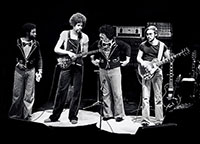
Jazz as a genre underwent a number of stylistic changes between the 1940s and the 1970s. As we will see, swing quickly gave way to bebop, a more virtuosic, solo-oriented style. Other musicians retreated inward, playing a subdued style of cool jazz. The musician at the forefront of many important developments in jazz was the trumpeter Miles Davis. He drew the most attention and controversy in 1970 when he released Bitches Brew, an album that fused jazz with rock. Bitches Brew is still considered the seminal jazz fusion a style of jazz that drew upon rhythms and instruments from rock music album, and it inspired an entire movement of jazz fusion artists in the 1970s, including Return to Forever, Herbie Hancock, and Weather Report.

“Miles Davis fully embraced possibilities and delved into it. He was criticized heavily from the jazz side. He was supposed to be part of a tradition, but he didn't consider himself part of a tradition.”
-Bill Laswell

“See, if you put a musician in a place where he has to do something different from what he does all the time, then he can do that - but he's got to think differently in order to do it. He's got to play above what he knows - far above it. I've always told the musicians in my band to play what they know and then play above that. Because then anything can happen, and that's where great art and music happens.”
-Miles Davis

"Miles Davis permanently damaged his vocal chords in 1957 when he shouted at a colleague days after undergoing throat surgery."
