
General Characteristics and Performance Practices of Gospel during Its Golden Age
As the genre matured and grew in importance greatly during its Golden Age, we will begin our discussion of its instrumental characteristics there. The Pentecostal sect nurtured gospel bands and believed that God made all instruments for praise and worship, as did King David of the Old Testament. In addition to tambourines, cymbals, and drums, they eventually added other ones such as the piano and organ—of particular note is the Hammond B-3 organ. Jazz bands in the New Orleans and Chicago jazz styles influenced the gospel bands that accompanied soloists and groups and played instrumentally during worship services, funerals, concerts, anniversaries, and various occasional events.
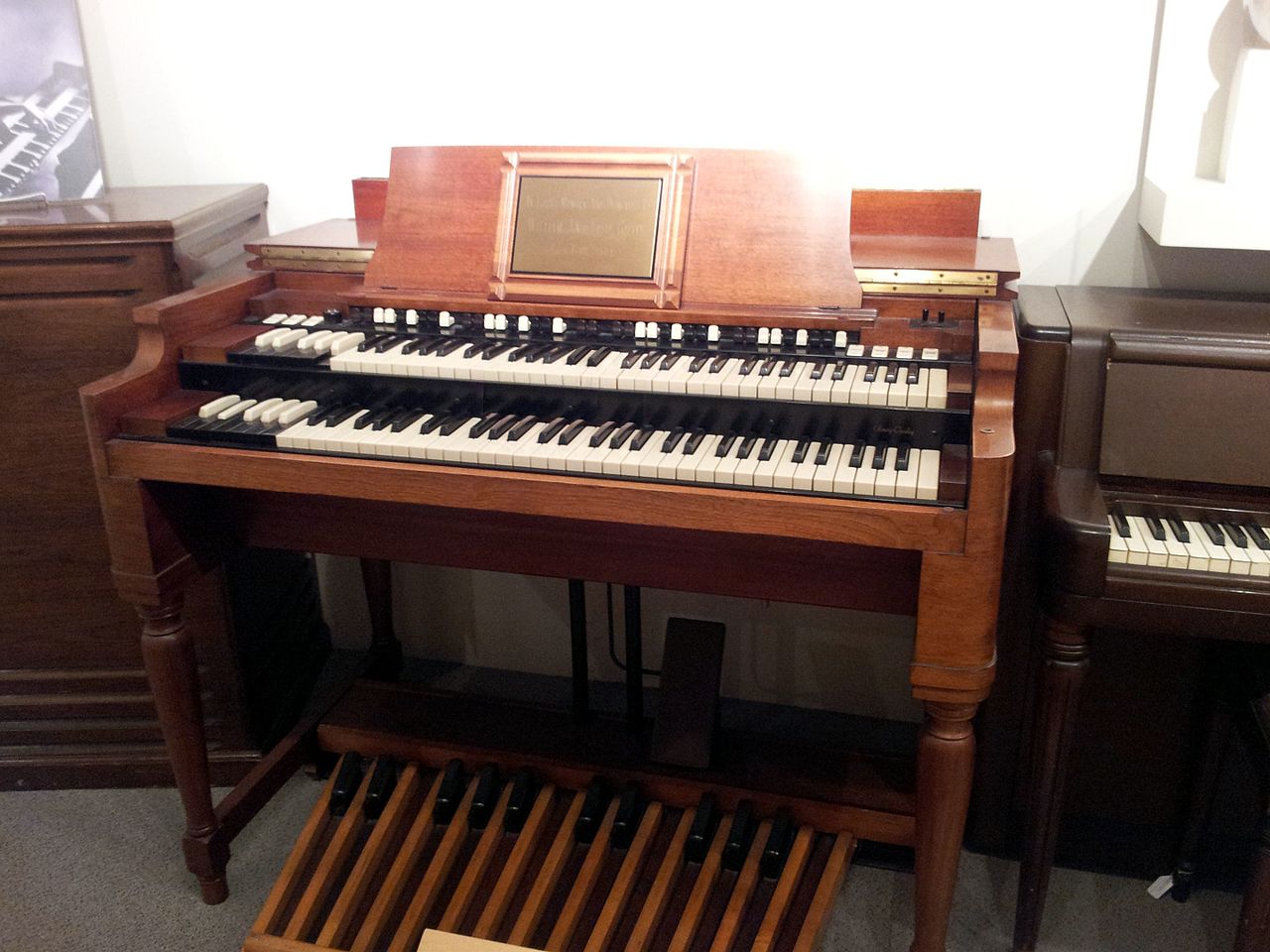
A few of these bands include Kings of Harmony (Washington, DC), Sons of Thunder (Brooklyn, NY), and Sounds of the South (Savannah, GA). Eventually, gospel bands became gradually more acceptable among congregants. They played more dynamically, rhythmically, or added an instrumental accompaniment as the response to the vocalist's call—such as the organ response to the singer heard in “Angel on Vacation” (starting at 00:29) by Alex Bradford and The Bradford Singers. And on occasion there would be an instrumental section between the singer's verses/chorus such as in this video (01:33-01:49) of the Clara Ward Singers performing “Swing Low Chariot” 
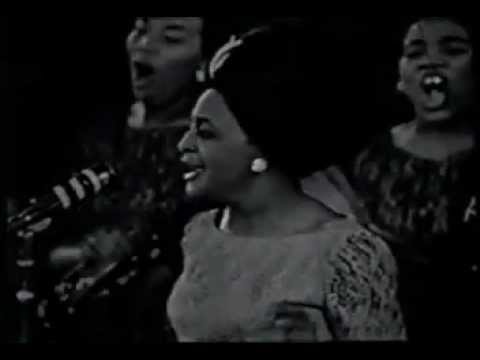
"Swing Low Chariot"- Clara Ward Singers
As was the case with the early gospel, during the golden age of the Gospel, instrumentalists also borrowed characteristics and performance practices heard in secular styles at the time (as will be shown later on), namely blues (use of blue notes and the 6/8 meter) and rhythm and blues (boogie-woogie and shuffle rhythm). For these reasons, we will also cover instrumental characteristics as illustrated in selected performances.
Whether in church or elsewhere, you can often hear and see the following characteristics of the gospel and its performance practices. The video below by The Clara Ward Singers performing “Travelin’ Shoes” and “When the Saints Go Marching In”, demonstrates the ensuing characteristics and performance practices:
The Clara Ward Singers
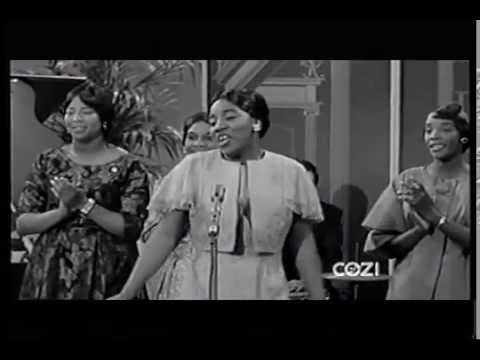
THE CLARA WARD SINGERS
| Use of tambourine | 00:07-01:26 (it is played throughout the entire song) |
| Call-and-Response | 00:10-00:24 (between the solo voice and background singers) |
| Repetition | 00:10-00:24 (such as the words "travelin' shoes" sung by the background singers) |
| Handclapping | 00:18-01:26 (the singers are clapping the backbeat, counts 2 and 4, throughout the entire song) |
| Lyrics are presented in a corroborative fashion | 00:24-00:31 (the lead voice makes a statement that is completed by the background singers) |
| Vamping | 00:49-01:06 (as the soprano holds a high pitch, the background singers “vamp” or repeat the same phrase “travelin’ shoes”) |
| Physical movement or dancing while singing or playing | 01:10-01:24 and 04:44-04:55 (the lead singer dances as a form of response to her lyric phrase) |
| Syncopation | 04:01-04:58 (syncopation is heard separately in the lead voice and background singers’ part, and when combined a greater since of syncopation is heard) |
| Change tempo | 03:53 (at this moment the tempo is at least twice as fast as before this time) |
| Walking in the audience to engage the audience on a personal level and encourage participation | 04:16-04:42 |
The following characteristics and performance practices apply to the voice and instruments:
Sound production
- Full-throated and chest vocal sounds (See above video “Travelin’ Shoes” by the Clara Ward Singers) - 00:24-00:48 and 02:02-02:49
- Natural voice and chest vocal sounds – 00:05-00:23 (as heard by the background singers in “Angel on Vacation” by Alex Bradford and The Bradford Singers)
- Humming and full-throated shout – 00:00-00:05(as heard in “Can’t Trust Nobody” by Alex Bradford and The Bradford Singers)
- Falsetto – 01:15-01:17 (as heard in “I Want To Be At Rest With The Lord” by Alex Bradford and The Bradford Singers)
Dynamics (to create dramatic contrast)
- The use of shouts/accents, crescendo, diminuendo, blue notes – 01:20-01:30 (as heard in “How I Got Over” by Clara Ward)
- Bending – 00:55-00:57 (this occurs when the background singers sing the word “pray” in the song “When You Pray” by Alex Bradford and The Bradford Singers)
- Melisma – 01:14-01:21 (many notes are performed on the word “if” in “If I Can Help Somebody” by Mahalia Jackson)
Please refer to the video below to see and hear the three performance practices below.
Alex Bradford – It’s a Highway to Heaven
- Maintaining rhythmical continuity – 04:04-04:06 (inserting vocables or one to three words between a passage are heard in the 1962 live video below of “It’s a Highway to Heaven” by Alex Bradford and The Bradford Singers in the Netherlands)
- Soprano voice sustaining a high pitch – 05:56-05:59 (as heard in the same video in the song “The Angels Keep Watching Over Me All Day” by Alex Bradford and The Bradford Singers)
- Handclapping – 01:37-01:51 (is used to increase energy as heard in “It’s a Highway to Heaven” of “Oh My Lord God” by Alex Bradford and The Bradford Singers)
- Using vocables such as “ooh,” “whoa,” “doo,” “yea,” - 00:15-01:45 (as heard sporadically by the background singers in
“Walk Through the Streets” by Alex Bradford and The Bradford Singers) - Background singers provide an accompaniment for the lead singer – 00:17-00:38 (background singers sing words as an accompaniment to the lead singer) - 00:39-01:01 (background singers “hum” as an accompaniment to the lead singer)
- A spoken passage with a song - 01:36-01:48 (as heard in
“Let the Lord Be Seen in You” by Alex Bradford and The Bradford Singers)
- Instrumental introduction – 00:00-00:15 (a brief piano introduction is heard in “One Step” by Alex Bradford and The Bradford Singers)
- Walking bass pattern – 00:00-until the end (as performed by piano and bass in, “Walk Over God’s Heaven” by Mahalia Jackson)
- Use of blue notes – 00:00-until the end (performed by piano and the organ as heard in “You’re Gonna Need Him”
- The pianist and/or organist intensifies and responds to the singer’s message with harmonies and brief accented passages – 00:02-00:08 (as heard in “What About You” by Alex Bradford and The Bradford Singers)
- One or more instruments accompanying the vocalist(s) more actively – 00:54-until the end (such as the organ in “The Lord Looks Out For Me” by Alex Bradford and The Bradford Singers)
- The music borrowing characteristics of the day's secular styles - 01:05-01:20 (as heard in “It’s a Highway to Heaven” by Alex Bradford and The Bradford Singers. Here, rhythms and playing techniques are indicative of New Orleans style of rhythm & blues)
- Use of the 6/8 meter - 00:00-until the end (as heard in “Remember Me” by The Caravans)
- Vamping or repetition - 0054-01:58 (as heard in “Your Friend” by Alex Bradford and The Bradford Singers)
The next section will cover various music characteristics, performance practices, and techniques specific to group sizes such as solo, quartet, vocal group, and choir.
Precious Lord
Through the storm, through the night
Lead me on to the light
Take my hand precious Lord, lead me home
It's a Highway to Heaven
It's a highway to heaven
None can walk up there
But the pure in heart
It's a highway to heaven
Walking up the king's highway