
Overview
Objectives
- Examine the relationship between music and the American civil rights movement during the 1960s
- Identify characteristics of Brown’s musical style from this period
- Identify some of the defining features and characteristics of funk music
- Recall the significance of Sly and the Family Stone in the development of funk music
- Examine the role George Clinton played in funk music during the 1970s with P-funk genre
- Examine how popular media such as Blaxploitation films and television programs helped promote African American music and musicians
George Clinton and P-Funk continued
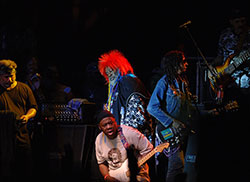
Clinton’s music also has several characteristics that are unique to P-funk. First, synthesizers play a prominent role in the P-funk sound. Bernie Worrell, Clinton’s primary keyboardist, used synthesizers to create melodies as well as sound effects. The synthesizer might be mimicking a horn or a voice in one passage and then shrieking, growling, or emitting other sound effects in the next passage. Parliament’s "Flash Light ♫" (1978) prominently features the synthesizer in dozens of sonic roles.
Most of Clinton’s music is not in any of the forms that we have encountered in popular music thus far. Instead, his songs unfold in a series of sections, and each section is marked by shifts in instrumentation, texture, or singing. One section may include a groove composed of tightly-knit instrumental riffs with group singing, and the next section will have a different groove altogether and feature a soloist. During the 1970s, Clinton frequently performed lyrics in a "rap" style. Although it sounds very different from the rapping that is heard in hip-hop, Clinton’s style of delivering lyrics rhythmically over an instrumental background was an important influence in the development of the style of rapping that developed later in the 1970s.
Parliament’s Mothership Connection (1975) is a concept album that takes place on an imaginary planet in the Chocolate Milky Way galaxy. Dr. Funkenstein and his crew visit earth in order to "bring back the funk." According to Dr. Funkenstein, African Americans once had "funk," a spiritual, social, and aesthetic force that had guided and empowered them during slavery. The second track on Mothership Connection is "Mothership Connection (Star Child) ♫," and it embodies many of the musical, lyrical, and theatrical aspects of Clinton’s music. The song is in two main sections that alternate, which creates an overall form of ABAB. The first section features short instrumental riffs, occasional singing, and "rapping" from Clinton. The second section introduces synthesizers, and the instruments’ lines are more melodic than in the first section. In addition, the second section of "Mothership Connection (Star Child) ♫" features group singing. The song’s lyrics are about Star Child, the alien deity whom Dr. Funkenstein sends to earth. According to Dr. Funkenstein, African Americans had had "funk" during slavery, but they had now lost it. By quoting the spiritual "Swing Low, Sweet Chariot" in the lyrics of "Mothership Connection (Star Child) ♫," Clinton creates a musical link between P-funk and the music of slavery. Co-written by Clinton, Collins, and Worrell, "Mothership Connection (Star Child) ♫" is a classic example of the Parliament sound and message from the mid-1970s.


“Soul was the music made by and for black people. For most of the Sixties it was thoroughly divorced from white popular music, but by the end of the decade several artists with their roots firmly in both soul and R&B traditions had crossed over.”

"Throughout the 1940s and early 1950s, [Sam Cooke] gained acclaim as a member of gospel harmony groups, including the Highway Q.C.s and the Soul Stirrers. At the time, the Soul Stirrers were considered the most respected gospel singing group in the US."
