
Learning Objectives
- Examine how triads may be built on any scale degree of the major scale and can be labeled using Roman numerals.
- Examine the types of triads that occur naturally in major keys.
Harmony I: Triads in a Major Key
Harmony
In previous sections of this course, we learned about keys, scales, and chords seperately. In this final section of the course, we will combine these concepts in an introductory study of harmony. Harmony describes how chords interact in keys to create meaningful chord progressions. We will not be able to pursue a thorough study of harmony here. (If you decide to continue studying music theory after this class, you will learn much more about harmony). The aspects of harmony that we will consider in this course are (1) the diatonic chords in major and minor keys; (2) basic Roman numeral analysis; (3) seventh chords; and (4) cadences.
Triads in a Major Key
We will begin our study of harmony by examining the chords that occur in major keys. You can build triads on any scale degree of a major scale, as illustrated below. Here, triads are built on the each scale degree of the C major scale. We call these diatonic chords because they are the chords that happen naturally in the key (or "tonality") of C major. Click "Show Me" to hear them played.
Triads Built on the Major Scale
As we learned earlier in our discussion of white-key triads, there are three major triads (labeled M), three minor triads (labeled m), and one diminished triad (labeled d) in the C major scale. We can name each of these triads after the scale degree of its root, as illustrated below.
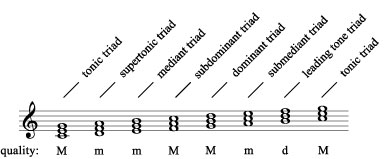
If we were to transpose this C major scale to begin on another pitch, the same types of triads would occur over the same scale degrees. See, for example, the D major scale below. Like the C major scale, it has a major triad on scale degree 1, minor triads on scale degrees 2 and 3, major triads on scale degrees 4 and 5, a minor triad on scale degree 6, and a diminished triad on scale degree 7. In fact, this chord pattern is the same for all major keys (as outlined in the rule below).

| Triads in a major key |
|
Roman Numerals
The triads in a major key can also be labeled using Roman numerals, as illustrated in the example below. Here, the numerals I through vii are used in place of scale degree numbers. Uppercase numerals indicate major triads (I for the tonic triad, IV for the subdominant triad, and V for the dominant triad). Minor triads are labeled using lowercase numerals (ii for the supertonic triad, iii for the mediant triad, and vi for the submediant triad). The leading tone triad is represented with a lowercase numeral and a diminished circle (viio).

This pattern of Roman numerals is the same for all major keys. Notice that the Roman numerals must be preceded by a key name (in this case, "D:") in order for the analysis to make sense.
The Roman numeral tells us the root, quality, and function of each triad in a key. For example, "I" in the key of D major indicates a D major triad (spelled D–F#–A), with a tonic function. A "V" in the key of C major would indicate a G major triad (since scale degree 5 in C major is G), with a dominant function. A "IV" in the key of F major would indicate a B-flat major triad (since scale degree 4 in F major is B♭), with a subdominant function. A "ii" in the key of E major would indicate an F-sharp minor triad (since scale degree 2 in E major is F#), with a supertonic function. And so on.