
Overview
The history and evolution of jazz—and the world inhabited by its innovators and practitioners—continues to provide a remarkable lens through which to view the larger American cultural landscape. The early 1950s United States was still a racially segregated society, especially in the South. And while the "color line" in jazz had been crossed more than a decade earlier, the terms of such interactions continued to be dictated by the dominant white culture.
In this section we will see how hard bop represents the maturation of bebop—its evolution, and how Charlie Bird and Dizzy Gillespie threw the doors open (or "blown" them open), ushering in not just a new style, but a new era—the modern jazz era.
Racial dynamics were also at play at the advent of hard bop. It's worth noting that many of the innovators of cool jazz were white, with the notable exception of Miles Davis and John Lewis. We will explore how emerging hard bop styles were motivated in part by black jazz musicians' desire to reclaim jazz as their own music.
Objectives
Upon completion of this lesson, you will be able to do the following:
- Identify musicians who created jazz that came to be known as hard bop
- Identify similarities and differences between bop and hard bop
Horace Silver
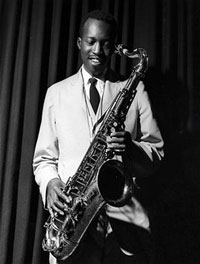
Horace Silver (b. 1928) was a distinct and prominent hard bop pianist, known for his brand of funky jazzA subgenre of hard bop, characterized by blues-inflected, repetitive piano grooves that often take the place of more customary comping —so called because his style of playing had a stronger connection to the blues than did most other jazz pianists at that time. Silver was also one of the most prolific composers of the era.
Silver grew up in Connecticut, learning at first to play tenor saxophone before switching to piano. His father was of Portuguese descent and hailed from the island of Cape Verde. His mother, of Irish African descent, was born in Connecticut. The Cape Verdean folk music sung by Silver's father was an early musical influence, and it helps account for the strong Latin rhythmic influence in much of Silver's music.
By 1950, Silver had put together his own trio and was playing in Hartford, Connecticut when his group was invited to back up Stan Getz for a gig. Getz was favorably impressed with Silver and his sidemen, and the trio toured with Getz for a year. Silver also did his first recording with Getz. In 1951, Silver moved to New York City, where there were more performing and recording opportunities.
Horace Silver's collaborations with Art Blakey began in 1953. We've already heard one of Silver's tunes in a live performance at Birdland, under the leadership of Blakey. In November 1954, Silver led their group for the first time in a recording session for Blue Note Records. The results confirmed Silver's leadership capabilities, as well as his compositional and performing brilliance.
Silver is a versatile composer, but he is especially known for the heavy "funky" blues inflections that permeate many of his works. Let's hear one of those, in this case a 12-bar blues. Listen now to Horace Silver's tune Doodlin' ♫, performed by the Jazz Messengers.
Notice the call-and-responseA musical “back-and-forth” characterized by alternations between two groups, or between a soloist and a group. character of the tune (0:00-0:23). Silver's "call" on piano starts almost a full measure before the initial downbeat and the "response" by the horns. The rhythmically-displaced repetitions of the response motif are reminiscent of another pianist-composer, Thelonious Monk. Like so many 12-bar blues pieces, we hear a repetition of the head (0:23-0:45), but then we are treated to a different call-and-response arrangement in the third chorus (0:45-1:09) before Silver leads off as soloist over the next three choruses (1:10- 2:20). Again, we hear a quotation in Silver's solo, at the beginning of his second chorus (1:34), as he uses the pickup to "When the Saints Go Marching In" as a springboard for the remainder of his solo. Over the next nine choruses we hear excellent solos from three of Silver's sidemen: tenor saxophonist Hank Mobley (2:21-3:32), trumpeter Kenny Dorham, and drummer Art Blakey (4:44-5:49).



In 1995, Horace Silver was named a National Endowment for the Arts Jazz Master and in 2005 he received a President’s Merit Award from the Recording Academy
