
Learning Objectives
- Classify intervals by their numeric size.
- Learn how to calculate and visually identify the size of intervals.
Intervals II: Interval Size
Interval Names
An interval name has two components: interval size and interval quality. A complete interval name must indicate both quality and numeric size. We will start by learning about interval sizes.
| Remember |
|
Interval Size
The size of an interval tells us the number of steps that the interval contains. We can represent this size by a number (1, 2, 3, 4, etc.) or by a label (unison, second, third, fourth, etc.). Here are the simple interval sizes:
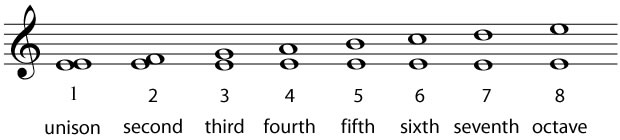
Note that instead of "first" we say unison, and instead of "eighth" we say octave. Intervals that are larger than an octave are called compound intervals. We will discuss them later on.
Calculating Interval Size
It is easiest to calculate interval size by referring to a staff (rather than a keyboard), because each line and space on the staff represents a step (or a letter name). Interval size can be calculated in one of three ways:
- By counting every letter name in the interval, including both the bottom and top pitches.
- By counting every line and space on the staff from the bottom note to the top note of the interval.
- By looking at the interval on the staff and determining its size based on its visual pattern of lines and spaces.
The first approach is to count the number of consecutive letter names that an interval contains. If the interval contains three letter names, it's a third. If it contains four letter names, it's a fourth, and so on. For instance, in the example below, we have the melodic interval from C to E. The letter names contained in the interval (starting from the bottom and moving towards the top) are C, D, and E. Click "Show Me" in the animation below to see these letter names counted. Since the interval contains three letter names, the interval size is 3, or a third. Note particularly that both the first and last pitches are counted as part of the interval size.
| The melodic interval C-E |
Interval of a Third
| Calculating the interval size from C to E |
We can also calculate the size of the interval by counting every line and space that make up the interval. C starts on the line below the staff, D is the space above it, and E is the first line of the staff. Two lines and one space = 3 letter names, or a third.
Here is another example with a much larger interval to measure, from C to B. The letter names contained in the interval (from bottom to top) are C, D, E, F, G, A, and B. Click "Show Me" in the animation below to see these letter names counted. Since the interval contains seven letter names, the interval size is 7, or a seventh. Note particularly that both the first and last pitches are counted as part of the interval size.
| The melodic interval C-B |
Interval of a Seventh
| Calculating the interval size from C to B |
Again, it would also be possible to calculate the size of the interval by counting every line and space in the interval. C starts on the line below the staff, D is the space above it, E is the first line of the staff, and so on. Four lines and three spaces = 7 letter names, or a seventh.
Whichever method you decide to use, remember these three points when doing your calculation:
- Count each letter name (or line/space) only once.
- Count from bottom to top.
- Always include the first and last letter names (or lines/spaces) of the interval.
Visually Identifying Interval Size
The third approach to identifying interval sizes is to learn to recognize them visually on the staff. In other words, you can recognize an interval immediately because you know what it looks like. This is quite easy to do with smaller intervals (like seconds and thirds) but becomes a bit trickier with larger intervals (like sixths and sevenths). Here are two simple rules that will help you to visually recognize intervals on the staff.
| Rule 1 |
|
In other words, odd numbered intervals (1, 3, 5, 7, etc.) will always have both notes on a line or both notes on a space. Look at the following three examples:
|
Third: Line to Line
|
Fifth: Space to Space
|
Seventh: Line to Line
|
The notes of a third always go from:
Thirds are "stacked" neatly on top of each other, with no room in between. |
The notes of a fifth always go from:
|
The notes of a seventh always go from:
|
| Rule 2 |
|
In other words, even numbered intervals (2, 4, 6, 8, etc.) will always have one note on a line and the other on a space. Look at the following three examples:
With practice, you can use these rules to quickly determine the numeric size of intervals up to the octave. Intervals larger than an octave are difficult to recognize using this approach. We will address how you can identify larger intervals later.
Now review all of the intervals from unison to octave. All of the intervals in the chart below start on middle C. Note how the odd-numbered intervals go from line to line on the staff and the and the even-numbered intervals go from line to space. Try to remember what each of the interval sizes looks like on the staff and, above all, listen carefully to each of of them by clicking on the speaker or on the individual notes.
| Odd-numbered Intervals | Even-numbered Intervals |
| Unison | Second |
| Third | Fourth |
| Fifth | Sixth |
| Seventh | Octave |
Accidentals and Interval Size
It is important to point out that accidentals do not affect interval size. In the example below, the numeric size of both intervals is identical—a third—since both intervals contain the same three letter names (C, D, E). In determining interval size, you can disregard the accidentals entirely. Adding an accidental to an interval does not alter its numeric size. Accidentals do affect interval quality, however, which is the topic of our next lesson.
| Two thirds | |