
Learning Objectives
- Define seconds, thirds, sixths, and sevenths as major/minor intervals.
- Examine how major/minor intervals may become augmented or diminished.
Intervals VI: Major/Minor Intervals
Major/Minor Intervals
In addition to the perfect intervals, there is a second category of intervals that can be either major or minor in quality. Listen to these pairs of major and minor thirds and seconds. Note that the minor-quality intervals are always a half-step smaller than the major-quality intervals, and vice versa. In other words, a major interval decreased by a semitone is minor and a minor interval increased by a semitone is major.
Major Third
Minor Third
Major Second
Minor Second
The major/minor intervals include seconds, thirds, sixths, and sevenths. These intervals can never become perfect, just as the perfect intervals can never become major or minor.
| Major/Minor Interval Rule 1 |
|
| Major/Minor Interval Rule 2 |
|
Minor and Major Seconds
A minor second is a second that contains 1 semitone. A major second is a second that contains 2 semitones. You are already familiar with these intervals under the names half step and whole step. Here are some minor seconds (m2) and major seconds (M2):

Since we have already worked with whole and half steps extensively in writing scales, it should be fairly easy for you to spell and identify major and minor seconds.
Minor and Major Thirds
A minor third is a third that contains 3 semitones. A major third is a third that contains 4 semitones. Major and minor thirds are particularly important because they are the building blocks of triads and harmony, as we will learn later in this course. Here are some minor thirds (m3) and major thirds (M3):

You can spell and identify major and minor thirds by counting the number of semitones they contain. This is relatively easy since the intervals are still fairly small. For example, if you were given the two pitches A and C#, you would start on the note A and count the number of semitones between A and C#, as illustrated in the example below.
Counting the number of semitones from A to C#
Since there are four semitones in this third, it is a major third. We will discuss an alternative method for recognizing major and minor thirds in the next lesson.
Minor and Major sixths
A minor sixth is a sixth that contains 8 semitones. A major sixth is a sixth that contains 9 semitones. Here are some minor sixths (m6) and major sixths (M6):
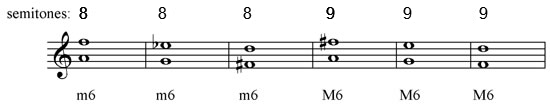
Minor and Major Sevenths
A minor seventh is a seventh that contains 10 semitones. A major seventh is a seventh that contains 11 semitones. Here are some minor seventh (m7) and Major sevenths (M7):

As the number of semitones increases, it becomes more and more challenging (and tedious) to spell and identify intervals by counting semitones. This is particularly true with sixths and sevenths. We will discuss alternative methods for spelling and identifying sixths and sevenths in the next lesson.
Augmented and Diminished Intervals
Like perfect intervals, the major/minor intervals can also be augmented or diminished. When a major interval is enlarged by a half-step, it becomes augmented. When a minor interval is reduced by a half-step, it becomes diminished. Thus there are four "states" for major/minor intervals: diminished, minor, major, and augmented. These points are all summarized in the following rule:
| Major/Minor Interval Rule 3 |
(smaller) dim — m — M — aug (larger) |
The interactive example below illustrates this rule. Click "Show Me" in the first example to see how altering the top note affects the quality of this third. First, the interval expands from major up to augmented, then contracts down again through major to minor and diminished. You can also click on "M," "m," "dim," or "aug" in the example to see how the intervals change.
Major Interval Quality Altering Top Note
| Interval quality altering top note |
Major Interval Quality Altering Bottom Note
| Interval quality altering bottom note |
The second example illustrates how altering the bottom note affects the quality of the interval (Click "Show Me"). Remember that by adding a flat to the bottom note the distance between the two pitches actually becomes larger ("lowering the floor"). Similarly, raising the bottom note with a sharp ("raising the floor") makes the interval smaller.
Note that in each of these examples the letter names A and C do not change. If we were to use A and D instead of A and C-double-sharp, this would not be an augmented third, since the interval size has changed to a fourth (A-B-C-D). Keep the letter names (and the interval size) the same when altering intervals.
Not all intervals are equally likely to occur in music. The only augmented and diminished intervals that occur with any regularity are the augmented second, the tritone, the augmented sixth, and the diminished seventh. All of the others are possible, but less likely.