
Learning Objectives
- Examine African musical culture and history by considering music in the community as an integral part of social and religious activities (i.e. the belief system of the Shona people of Zimbabwe and the initiation rites of the Mende people of Sierra Leone).
- Analyze how and why music plays an important role in sustaining social values and maintaining the continuous relevance of traditional African institutions.
- Distinguish the regional similarities and differences between African musical instruments not only in terms of construction and performance, but also in terms of the symbols they represent (i.e. African drum languages and the Mbira).
- Analyze the role the human voice plays in displaying variety in form, such as call and response, as well social organization in African music.
- Identify the variety of African drum languages and their function to imitate the speech contours of words from various African cultures.
- Analyze the functions of modern popular African music, a relatively new musical idiom that developed in the early part of the last century.
Introduction
African musical traditions are marked by a variety that reflects the continent's ethnic, national, and regional diversities. The second largest and the second most populous continent in the world, Africa comprises over fifty countries. The diversity of its ethnic profile is reflected in the over 1000 indigenous languages that are spoken across the continent. Lying to the north of this vast continent is the Mediterranean Sea, which separates Africa from Europe. At the northeastern border sit the Suez Canal and the Red Sea. The Indian Ocean lies to the southeast, while the Atlantic Ocean forms the western border of the continent.
The Sahara desert separates North Africa from the rest of the continent. North Africa is home to Arab countries such as Egypt, Algeria, and Morocco, while the area south of the Sahara (usually referred to as Sub-Saharan Africa) is inhabited by a predominantly black population living in countries such as Senegal, Ghana, Kenya, and South Africa, just to mention a few. The migration of people, thousands of years ago, from areas within present-day eastern Nigeria and western Cameroon to locations in the east and southern parts of the continent formed part of the basis for similarities in cultural practices, including musical styles, across different parts of Africa. In spite of commonly-shared traditions, however, cultural practices across the continent reflect significant differences, especially as facilitated by geographical conditions and historical factors.
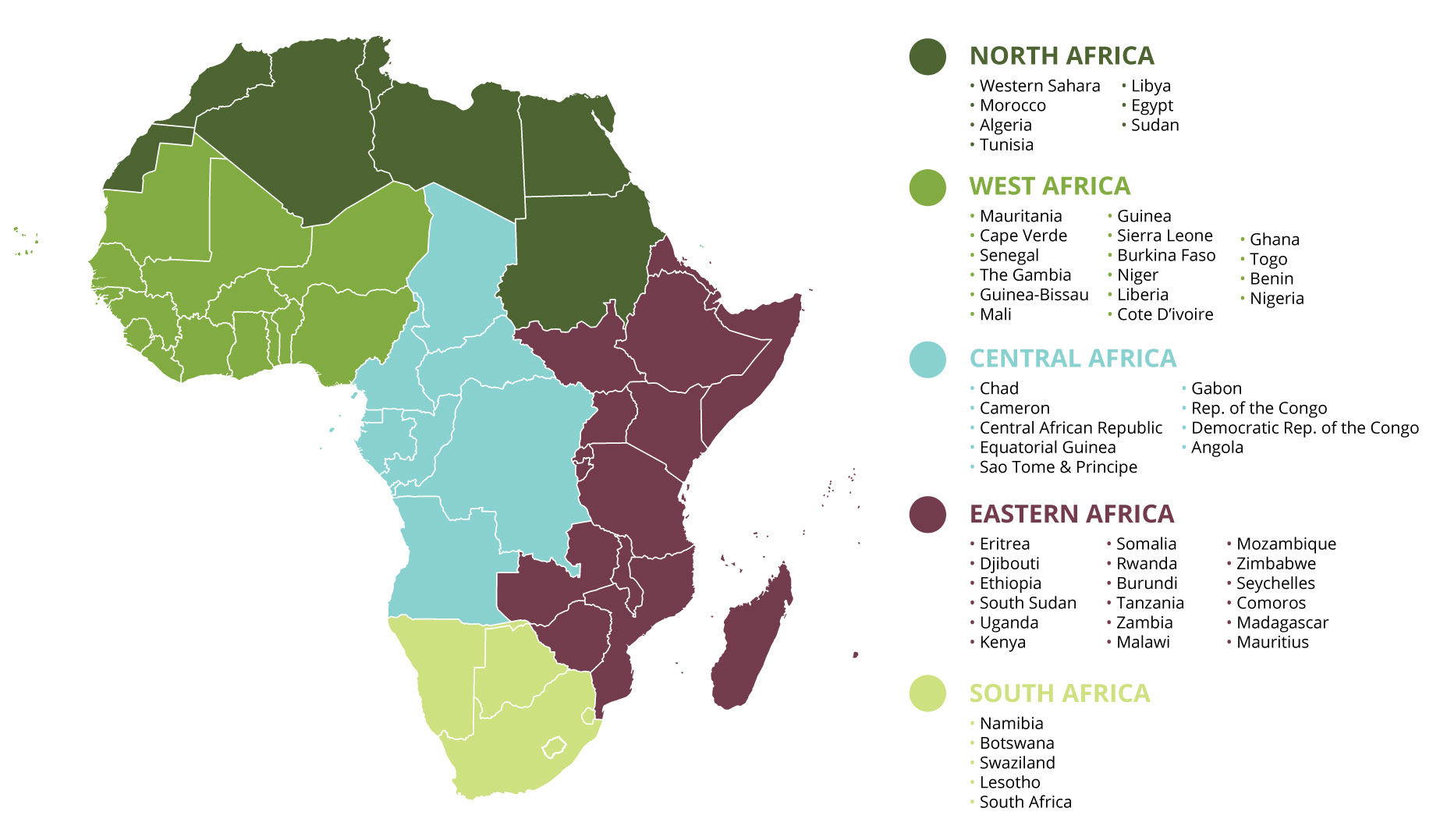
The continent is often divided into five regions: Northern, Western, Eastern, Central, and Southern Africa. Mouse over the colored areas in the following graphic to see these regions.
European colonization of Africa gathered significant momentum in the late 19th century and saw the vast continent divided amongst countries such as Britain, France, Spain, and Portugal.
Prior to this period, the African continent existed largely as a series of empires and kingdoms with sophisticated political structures ruled by powerful kings who combined political and spiritual roles.
Some of the most prominent empires were as follows:
- Ghana (700-1200)
- Mali (1200-1500)
- Songhai (1350-1600)
- Zimbabwe (1100-1500)
- Benin (1300-1800)
- Kanem-Bornu (800-1800)
In addition to these centralized political systems were stateless societies, such as the Igbo people of present-day Nigeria, which were coordinated by local chiefs and councils of elders.



African people made instruments from materials available to them, like wood, gourds, animal horns and skins.
