
Learning Objectives
- Analyze selected works of different styles and genres from a broadly representative geographical range to examine how Latin American concert music has been understood in the international musical community.
- Examine the music of select indigenous peoples of South America.
- Analyze the impact by European colonial powers to expunge South American indigenous languages, music, and religious practices.
- Examine the musical impact of African slaves on the music of South America, such as call and response, the use of percussion instruments, and capoeira (an elaborately choreographed martial art), to name a few.
- Identify indigenous composers who were trained by the missionaries, such as the early nineteenth-century composer Manuel Dias de Oliveira (1764-1837), who synthesized European musical styles in music such as the samba, samba-reggae, and bossa nova.
- Examine how Latin American vernacular music, such as the Brazilian bossa nova or the Colombian cumbia, has been used to mark holidays, enliven repetitive or physically demanding work, celebrate national identity, and express other aspects of the human condition.
- Analyze Latin American concert music, the impact of Hollywood on it, and how protest songs, corridos, and operas based on the tumultuous history of Latin America inspired both North and South American composers.
Introduction
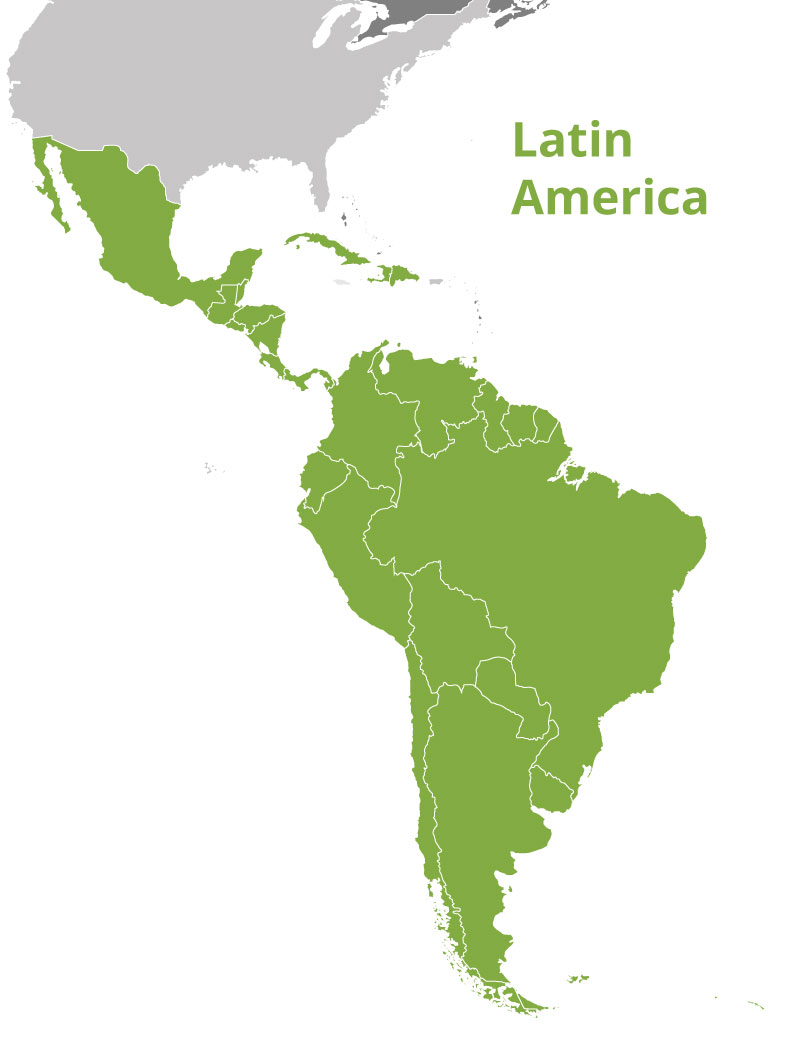
Two words that appear over and over in writings on Latin America—and with good reason—are "variety" and "contrast." The American continent is, indeed, a land of wide, fascinating, and often contradictory divergence in just about every way. The Amazon Basin is very different from the Andean region, which, in turn, is nothing like the Argentine pampas or the glaciers of the southernmost tip of the continent. There is similar contrast among Latin American cities, from the urban sprawl of greater São Paulo to the ocean breezes in Lima to the frogs that serenade the residents of Caracas on damp evenings. As for the human landscape, it consists of a variety of ancestries, ethnic groups, and races whose specific composition varies from country to country: Many have a predominance of European-Amerindian or Mestizo population; in others, Amerindians are a majority; some are dominated by inhabitants of European ancestry; and some countries' populations have large African or Mulatto populations.
Though Portuguese is the official language in Brazil, Spanish—the dominant language in the rest of Latin America—varies greatly in vocabulary and pronunciation from country to country while various indigenous languages are still spoken in parts of the continent. Religious orientations are similarly diverse. Although we might be tempted to imagine all Latin Americans as Catholics, practicing or not, Protestantism continues to make significant inroads. Nor is the Catholic Church monolithic: in the 1980s, Catholic Liberation Theology challenged Church teachings, causing consternation in the Vatican.

Amerindian cultures practice a variety of religions, even as aspects of African religious rituals continue to be practiced, as they have throughout the centuries.
For all these reasons, the political borders that separate Latin American countries are entirely artificial.

An area such as the Orinoco River basin, which embraces portions of modern-day Venezuela and Colombia, is a perfect example of how the people who live in a given environment ignore political boundaries drawn on a map. Similarly fluid are the psychological "borders" between Latin America and the U.S.. Political and economic power struggles have often soured U.S.-Latin American relationships. Yet during other periods in history, the idea of a single "American continent" has been a shared goal.
Latin American music reflects these geographic, linguistic, social, and political realities. This chapter introduces Latin American indigenous, African, and vernacular music, and their relation to concert music in this region of the world. Before going further, we need to make sure we understand these terms. As used here, "vernacular" means music that is not the product of highly specialized training but rather, arises as a spontaneous reflection of a culture, almost in the same way a native language is learned. Closely related terms are "popular," "folk," or "traditional."
On the other hand, concert music refers to music that is performed in a concert setting, such as a recital hall, symphony hall, opera house, or parlor. Different classes or categories of concert music are called genres. These include chamber music (music for small instrumental ensembles with one instrument per part), salon music (lighter or less profound works, often for solo piano), solo songs, choral, or symphonic music. Although some might imagine that the term “concert music” suggests snobbery—or at least distance from music that might be sung in the fields or at a political rally—Latin American concert music often embraces indigenous, African, and vernacular elements in all their vitality. To illuminate these concepts, we will listen to selected works of different styles and genres from a broadly representative geographical range. We will also touch briefly on the question of how Latin American music has been understood in the international musical community. In sum, these lessons will give you the tools to learn more about Latin America and the fascinating musical panorama it offers.



