
Overview
The history of jazz rightly begins in the city of New Orleans. In this section, we will learn about great New Orleans jazz musicians and their early recordings in Chicago. In the process, will also learn about the emerging Chicago jazz scene and some of the artists from that area who helped develop early jazz musical styles. Finally, we will do a short overview of early jazz in New York.
Objectives
Upon completion of this lesson, you will be able to do the following:
- Define collective improvisation
- Identify early jazz musicians and their contribution to jazz music
- Appreciate the significance of Dixieland jazz
- Recognize the impact Chicago had for musicians of early jazz
- Recognize the growing importance of New York for further developments in jazz
- Define chord substitutions
James P. Johnson
Concurrent with developments in Chicago, a northeastern jazz scene was coalescing in Harlem, pioneered by "the father of stride piano," James P. Johnson (1894-1955).
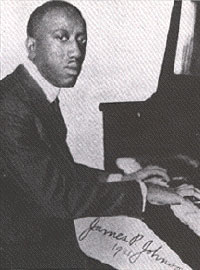
Stride pianoA style of jazz piano derived from ragtime in which the left hand alternates between bass notes and chords on successive beats of 4/4 time, creating an “um-pah, um-pah” foundation underneath the right hand’s melodic embellishments and improvisations. is an early jazz style that developed out of ragtime, characterized by the alternation in the left hand of bass note and chord. That is, bass notes on beats one and three, chords on beats two and four ("oom-pah, oom-pah"). The right hand is then free to play melody and other figurations.
Johnson was a prolific composer, and his interests reached beyond the world of jazz. He once collaborated with the poet Langston Hughes on an opera. But he is best known for his contributions to the Jazz Age, as the 1920s were known, notably through his most popular piece, The Charleston ♫.
Listen to his recording from 1925, and take note of the memorable "Charleston rhythm" that enters halfway through the introduction (0:05), then returns less than half-a-minute later (0:30) to permeate the remainder of the piece. While Johnson's stride style draws much of its energy from ragtime, he demonstrates a remarkable capability to maintain the forward momentum, whether or not his left hand is maintaining the stride rhythm.



Alicia Keys covered Fats Waller's "Ain't Misbehavin'" for the 2013 movie The Great Gatsby, starring Leonardo DiCaprio and Carey Mulligan.
