
Overview
In the early 1940s, a number of innovative and daring jazz musicians began searching for a new style. In after-hours jam sessions, they experimented with new melodic and harmonic vocabularies that challenged listeners and musicians alike. This music would come to be known by its onomatopoeic description: bebop.
In this section, we will first focus on the two principal innovators of this new jazz style: Charlie Parker and Dizzy Gillespie. We will also discover how the swing-style jazz of Count Basie provided a basis for the transition to bebop and the advent of the modern jazz era. In the second half of the section, we will discover other influential musicians who helped shape bebop and modern jazz.
Objectives
Upon completion of this lesson, you will be able to do the following:
- Identify Charlie Parker and Dizzy Gillespie as the principal innovators who contributed to the development of bebop
- Appreciate bebop as a new approach that ushered in modern jazz
Jazz Big Bands
Dizzy Gillespie was not the only leader of a modern jazz big band. The big band was — and is — to jazz what the symphony orchestra is to classical music. It continues to offer musicians an ensemble of relatively fixed instrumentation for which to compose. Even though the swing era was coming to an end in the late 1940s, the big band continued to draw its advocates.
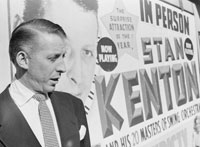
Stan Kenton (1911-1979) wrote arrangements for his band that included the harmonic vocabulary of bebop, music that has been labeled "progressive jazz." His vision was to move big band jazz from the dance hall to the concert stage. Kenton was also an early champion of jazz education, establishing jazz camps around the country. His greatest jazz legacy is arguably his contribution to the proliferation of jazz bands in the high schools and colleges throughout the United States.
Woody Herman (1913-1987) was a clarinetist/saxophonist and big band leader who had a marvelous penchant for bringing together all-star ensembles. Herman's "herds" (as they were known) underwent numerous incarnations through the 40s and the 50s, perhaps the most memorable being the Four Brothers Band (a.k.a. the "Second Herd"). The band was so named for the reed section — four saxophone players whose ensemble playing was breathtaking — and for the tune composed and arranged for them by Jimmy Giuffre entitled Four Brothers ♫.
It's a 32-bar song form in which the reed section plays the predominantly eighth note tune in harmony — what is referred to as a soliPlural for solo. (plural for solo).
The "four brothers" (three tenors and a baritone) reflect the influence of bop as well as the influence of bop's immediate predecessor, the Basie swing style (which includes the style of Basie's star tenor saxophonist, Lester Young). Not only is their ensemble playing superb, each takes his turn serving up a tasteful solo.
Zoot Sims leads off on tenor sax, soloing over the first half of the second chorus (0:36-0:52). Next is Serge Chaloff on baritone sax, who solos through the second half of the chorus (0:52-1:09). The two remaining tenors split the third chorus, Herbie Steward covering the first half (1:10-1:27) followed by Stan Getz (1:27-1:44). Of the four, Getz's solo is perhaps most reminiscent of the style of Lester Young. At this time, Getz was just emerging as an extraordinary talent, but eventually became the best-known of them. We will hear from him again.
Let's listen now to Woody Herman's band perform Four Brothers ♫.



Sarah Vaughan entered the talent contest at Harlem's Apollo Theater on a dare from friends. She sang her version of "Body and Soul" and won 1st prize.
