
Learning Objectives
- Outline the social, cultural, and political impact of WWI and WWII.
- Discuss the growth of the United States as a world power.
- Describe the impact of technological advancements on the development of music in the twentieth century.
- Describe, compare and contrast the main stylistic differences of Contemporary music styles including impressionism, post-Romanticism, serialism, and expressionism.
- Summarize the changing nature and application of the concept of tonality throughout the century.
- Discuss the impact of Claude Debussy's "Prelude to the Afternoon of a Faun" in light of the Symbolist movement in literature.
- Illustrate how the Russian composer Igor Stravinsky experimented with rhythm, new instrumental combinations, and the percussive use of dissonance, and discuss the impactof these techniques on contemporary music.
- Describe the impact of Arnold Schoenberg and the Second Viennese School on 20th-century music.
- Distinguish the main stylistic differences of nineteenth- and twentieth-century composers and styles.
- Describe the musical and political impact of “national schools” of composition that developed across Europe during the 20th century.
- Explain the impact of composer Aaron Copland on American contemporary music.
- Describe the impact of Latin American composers on the larger "art music" scene and repertoire.
- Define and analyze the main differences between jazz, ragtime, and blues.
Music of the 20th and 21st Centuries (1900-Present)
Currents in the New World: United States
Joan Tower

Joan Tower was born in New Rochelle, just north of New York City. When she was nine, her father, a mining engineer, moved the family to Bolivia, South America. The country's drum-rich music awakened a self-proclaimed passion for rhythm that is clearly manifest in some of her later compositions, such as Tambor (the Spanish word for drum), which was commissioned and premiered by the Pittsburgh Symphony.
Tower writes of Tambor:
While I was writing this piece, the strong role of the percussion began to influence the behavior of the rest of the orchestra to the point that the other instruments began to act more and more like a percussion section themselves. In other words, the main "action" of the work becomes more concerned with rhythm and color than with motives or melodies (though these elements do make occasional appearances here and there).
Initially active as a pianist—from 1969 to 1984, she was pianist and founding member of the Naumburg Award-winning Da Capo Chamber Players—Tower turned to composition in the 1960s. Early on, her music incorporated serial techniques, but during the 1970s, influenced by the music of Messiaen and Crumb, she began writing more approachable, lyrical, melodic works that are also characterized by a powerful rhythmic drive and rich instrumentation.
In 2001, some of the smaller-budget orchestras in the United States decided to jointly commission a work from a major American composer since none of them alone had the financial resources to do so. The Ford Motor Company and other organizations offered their support, and the Made in America project was born. Joan Tower was chosen as the first composer to participate and, appropriately, decided to give that name to the composition she created for the unprecedented project.
Tower said that the "American the Beautiful" theme inevitably appeared in her head as she approached the project, and so she decided to use it. The tune begins gently in the winds and then reappears in various versions throughout the work, sometimes interrupted and challenged by other music but always reasserting itself. In her program notes, she writes: "A musical struggle is heard throughout the work. Perhaps it was my unconscious reaction to the challenge of how do we keep America beautiful." The Glen Falls Symphony Orchestra of New York State premiered Made in America in October 2005. After two years and forty-nine states, the piece reached Alaska and was performed by the Juneau Symphony in June 2007. The recording you will hear, with the Nashville Symphony conducted by Leonard Slatkin, won three 2008 Grammy awards in the categories of Best Classical Album, Best Orchestral Performance, and Best Classical Contemporary Composition.
In her own words...
"When I started composing this piece, the song 'America the Beautiful' kept coming into my consciousness and eventually became the main theme for the work. The beauty of the song is undeniable and I loved working with it as a musical idea. One can never take for granted, however, the strength of a musical idea as Beethoven (one of my strongest influences) knew so well. This theme is challenged by other more aggressive and dissonant ideas that keep interrupting, interjecting, unsettling it, but "America the Beautiful" keeps resurfacing in different guises (some small and tender, others big and magnanimous), as if to say, "I'm still here, ever changing, but holding my own." A musical struggle is heard throughout the work. Perhaps it was my unconscious reaction to the challenge of how do we keep America beautiful, dignified and free."
Joan Tower
The New Yorker hailed Joan Tower as one of the most successful woman composers of all time. Her bold and energetic music, with its striking imagery and novel structural forms, has won large, enthusiastic audiences worldwide. As a composer, conductor, pianist, and educator, Tower has a number of artistic and academic accomplishments to her name. To list just a few: in 1990, she became the first woman ever to receive the Grawemeyer Award in Composition—one of the most prestigious honors any composer can win—for her orchestral piece Silver Ladders. In 1998, she was inducted into the American Academy of Arts and Letters, and that same year she won the Delaware Symphony's coveted Alfred I. DuPont Award for Distinguished American Composer. In the fall of 2004 she became a member of the Academy of Arts and Sciences at Harvard University, and in 2006, received an Honorary Doctorate from the New England Conservatory. She has been Composer-in-Residence for some of the most prestigious American orchestras, and she has conducted eight of the orchestras that participated in the Made in America project.
Since 1972, Tower has taught at Bard College, a private liberal arts college in Annandale-on-Hudson, New York, where she is Asher Edelman Professor of Music. Tower lives in Annandale-on-Hudson, New York.
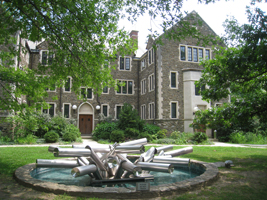
Faculty offices at Bard College, New York