
Overview
The history of jazz rightly begins in the city of New Orleans. In this section, we will learn about great New Orleans jazz musicians and their early recordings in Chicago. In the process, will also learn about the emerging Chicago jazz scene and some of the artists from that area who helped develop early jazz musical styles. Finally, we will do a short overview of early jazz in New York.
Objectives
Upon completion of this lesson, you will be able to do the following:
- Define collective improvisation
- Identify early jazz musicians and their contribution to jazz music
- Appreciate the significance of Dixieland jazz
- Recognize the impact Chicago had for musicians of early jazz
- Recognize the growing importance of New York for further developments in jazz
- Define chord substitutions
Joe "King" Oliver
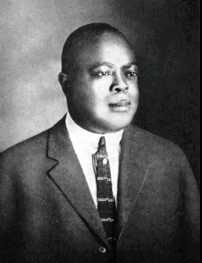
Joe "King" Oliver (1885-1938) was a cornetist and bandleader who earned his nickname as the leading cornetist in New Orleans. Oliver moved to Chicago in 1918 and began to lead his own band in 1920. After a brief stint in California, his band landed a long-running, multi-year engagment in one of Chicago's most popular dance halls, Lincoln Gardens. He made some of the earliest recordings of New Orleans jazz in 1923. Oliver brought together a first-rate group of musicians, which took the name King Oliver's Creole Jazz Band and included a young, emerging talent also on cornet — Louis Armstrong.
Let's listen to one of Oliver's tunes, Dippermouth Blues ♫. Notice the way in which the various instruments blend. It's as though each instrumentalist is doing his or her own thing, yet there is a cohesion to the overall sound.Musicians describe this sort of texture as polyphonicLiterally, “many sounds”; a term to describe the texture of New Orleans jazz., literally meaning "of many sounds." This is the essence of the collective improvisationA characteristic feature of New Orleans jazz in which multiple instrumentalists improvise together according to agreed-upon conventions. of the New Orleans styleThe earliest jazz, created and performed in and around New Orleans during the first two decades of the twentieth century by African Americans..
As we observed earlier, there are three prominent passages of collective improvisation in this recording (0:05-0:36, 1:10-1:26, and 2:15-2:31). We also hear another characteristic technique associated with the New Orleans style: stop time. Time doesn't really stop, but the band initiates a series of repeated accents that create silent spaces to be filled by a soloist.
The simplest version of stop time occurs when a band sounds only on the downbeat of each measure. In this case, though, everyone (except the clarinetist — who is the soloist) sounds on the first three beats of each measure ("1 2 3 . . . 1 2 3 . . . 1 2 3"), effectively opening up the second half of each measure.
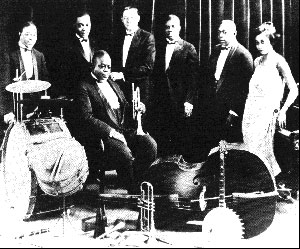
In this way, we better hear clarinetist Johnny Dodds, as he solos over two blues choruses (0:37-1:08).
Notice, too, Oliver's cornet solo over three choruses (1:24-2:08). His distinctive "wah-wah" was one of the bandleader's signature sounds. It's also worth noting the overall character of New Orleans style jazz, a spirited sound that conveys a marvelous sense of exuberance.



Louis Armstrong was cast in the 1936 film Pennies from Heaven, starring Bing Crosby. This led to frequent appearances in TV and film, adding to his fame.
