
Learning Objectives
- Relate how Romantic poets and artists abandoned traditional subjects, turning instead to the passionate and the fanciful.
- Relate how the Industrial Revolution impacted the technological development and affordability of musical instruments.
- Analyze how the orchestra grew in size and sound as new instruments were introduced and composers demanded greater levels of expression.
- Illustrate how Romantic composers explored nationalistic folklore and exotic subjects.
- Identify the form of romantic period songs, including strophic, through-composed, and the modified strophic forms.
- Examine the German art song (or Lied) as a favored romantic period genre.
- Discuss how the music of Franz Schubert impacted romantic period music.
- Discuss how the music of Frédéric Chopin impacted romantic period music.
- Trace the ascendance of program music in relation to absolute music.
- Summarize how political unrest throughout Europe stimulated the formation of schools of musical nationalism in Russia, Scandinavia, Spain, England, and Bohemia among other countries.
- Differentiate between the distinct national styles of romantic opera in France, Germany, and Italy.
- Discuss how the Italian nationalist composer Giuseppe Verdi impacted romantic period music.
- Trace how choral music became a popular artistic outlet for the middle classes.
- Discuss how the Russian composer Pyotr Ilyich Tchaikovsky impacted romantic period music.
Romantic Period (1820–1910)
The Traditionalists
By the mid-19th century, only a handful of composers remained to dominate the musical landscape. Schubert, Schumann, Mendelssohn, and Chopin had died prematurely, Rossini had retired, and Berlioz and a few others were left to toil under the long shadow of Beethoven. If there was one dominant figure in Europe in 1850, it was Franz Liszt, whose charismatic personality and programmatic approach to composition introduced new musical ideas and expressions and attracted many followers.
A number of young composers who emerged from this time period shared several traits: a reverence for the music of the masters, a commitment to established tradition, and an unparalleled knack for expanding traditional forms without discarding them. In company with Antonin Dvořák, whose works were expansive odes to classical form alongside traditional Czech folk elements, Johannes Brahms, Giuseppe Verdi, Peter Ilyich Tchaikovsky, and Anton Bruckner were some of the most important composers of the period who looked to tradition as the basis for their compositions.
Johannes Brahms
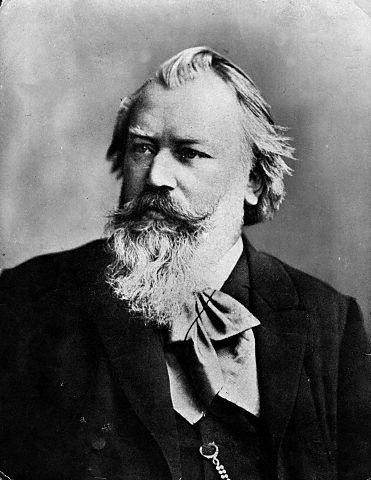
Johannes Brahms was a firm believer in preserving the musical traditions of Bach, Haydn, Mozart, Beethoven, and Schubert. By focusing on thematic development, choral voicing, and orchestration, he expanded traditional Classical forms. At the same time, his music's startling changes in harmonic structure and rhythmic variety distinguish him as one of the most original composers of the Romantic era. Nevertheless, tradition remained intact in Brahms’ music. He even returned to pre-Classical forms and harmony at times, employing Baroque forms such as the passacaglia and using modal harmonies reminiscent of Renaissance choral music.
Brahms came from a poor family. As a young child of ten, he played piano for money in the bars and brothels of his native Hamburg. During his formative years, he studied with the pianist Eduard Marxsen. At the age of 20, while on tour as an accompanist to the violinist Eduard Reményi, he met Joseph Joachim and Franz Liszt. Joachim arranged for him to meet Robert and Clara Schumann. This meeting was a defining moment in Brahms' life. The Schumanns immediately recognized the young pianist’s ability and charisma and offered him direction and support. Clara, a brilliant pianist and composer in her own right, also became a guiding force in Brahms’ life.
Composer: Johannes Brahms
-
"Violin Concerto in D major, Op. 77: III: Allegro Giocoso"
Brahms' work
Brahms's interest in German folk music may be heard in his early choral works, including the Liebeslieder Waltzes (Love-Song Waltzes) and his early songs. His greatest contribution to the choral repertoire was his masterpiece A German Requiem (1868), a seven-movement work with text from the German Bible. The German Requiem was not in the same vein as Mozart’s or Berlioz’ setting of the traditional Latin text, but rather a highly personal work created to memorialize his mother. In contrast to the "Dies irae" ("Day of Wrath") text found in the Latin version, Brahms' treatment was intended to console and illustrate the redemptive power of death. In the peaceful fifth movement, Brahms showed a masterful treatment of harmony that shifted through unexpected keys and cadences.
Composer: Johannes Brahms
-
"A German Requiem, Op. 45: V. Ihr Habt Nun Traurigkeit"
It is in his chamber and symphonic music that Brahms' traditional tendencies became most apparent. The Piano Quintet in F minor, Op. 34 (1864) illustrates a feature common to many of Brahms’ compositions: a complex texture or “thickness” that comes from the composer’s interest in thematic integration.
Composer: Johannes Brahms
-
"Piano Quintet in F Minor, Op. 34: III. Scherzo: Allegro - Trio"
In his chamber music and symphonies, Brahms is the true descendent and inheritor of the “Beethoven tradition.” Extremely self-critical, Brahms was hesitant to finish his first symphony because he felt an overwhelming responsibility to match Beethoven’s symphonic greatness. Thus, his First Symphony, one of only four symphonies that he composed, was not completed until 1876. Nevertheless, all four symphonies are considered massive achievements in the genre, unparalleled in scope and execution and in perfect, Classical form. The final movement of the Fourth Symphony in E Minor is a passacaglia with 32 variations. A work based on such a demanding form would be daunting to most composers. In the hands of Brahms, however, it became one of the most compelling movements in the symphonic repertoire.
Composer: Johannes Brahms
-
"Symphony No. 4 in E minor, Op. 98: IV. Allegro energico e passionato - Piu allegro"