
Key Signatures: Introduction
If musicians had to write a sharp or a flat in front of every note that required an accidental, the notation would become busy and very difficult to read. Compare the following two examples. In the first example, the accidentals from the key of C-sharp major are written into the score. (You may recall from an earlier lesson that C-sharp major requires all seven sharps.) In the second example, these required accidentals are written as a key signature at the beginning of the staff. Both of these examples will sound the same. Which one do you think would be easier to read and to play?
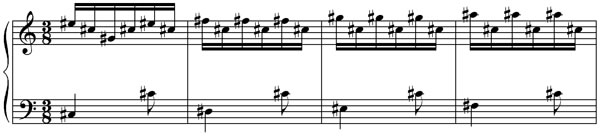
J. S. Bach's Prelude in C-sharp Major (no key signature)
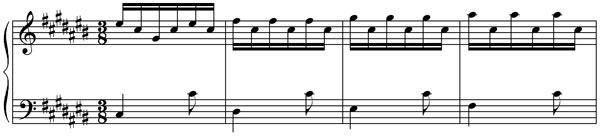
J. S. Bach's Prelude in C-sharp Major (with key signature)
A key signature is a collection of sharp or flats that are required in a key. The key signature is placed at the beginning of the staff, just after the clef. Click "Show Me" in the example below to see how the accidentals in the key signature of C-sharp major derive from the notes of the C-sharp major scale.
The key signature for C-sharp major
All of the accidentals in the key of C-sharp major are represented in this key signature. But you will note that the sharps in the key signature are not always in the same octave as those in the music. This is because the accidentals in a key signature occur in a particular pattern on the staff that does not change; F# is always positioned on the top line, C# is always positioned on the third space, and so on.
Accidentals that are written in the score apply only to notes written on the same line or space in the same measure. But the accidentals in a key signature apply to all of the notes in the composition, regardless of the octave in which they occur. Each symbol applies to all notes in the same pitch class—all C's, F's, B's, and so on. So, for instance, if there is an F# in the key signature, then all of the Fs in the music should be played as F#s—not just the Fs that are notated on the top line of the staff. In the example above, note how both of the C#s in the scale (C#4 and C#5) are represented by a single C# in the key signature.
The accidentals in a key signature are also written in a particular order, regardless of the order of the accidentals that occur in the music. The order of sharps is always F, C, G, D, A, E, B. For flats, it is the reverse order: B, E, A, D, G, C, F. To fully understand key signatures, you will need to become familiar with the the order and position of the accidentals in both sharp key signatures and flat key signatures (no key signatures will have both sharps and flats in them). In the lessons that follow, we will learn the sharp key signatures first and then the flat key signatures. The following rules will apply to both types:

Remember:
- Key signatures indicate which pitches should always be played with accidentals
- An accidental in the key signature applies to all of the notes with the same letter name, regardless of octave
- The accidentals (sharps or flats) in a key signature always appear in the same position on the staff
- The accidentals in a key signature always appear in the same order
- Sharps and flats do not appear together in the same key signature

- Memorize and recite quickly the order of sharps: F, C, G, D, A, E, B
- Memorize and recite quickly the order of flats: B, E, A, D, G, C, F