





Music of the 20th and 21st Centuries (1900-Present)
Music of Modern Europe: Electronic Music and Other Trends
György Ligeti
Ligeti was one of the rare composers of the second half of the 20th century whose music, despite being avant-garde, had (and continues to have) wide popular appeal. His works, still performed widely, are appreciated by critics and public alike. Film director Stanley Kubrick used the orchestral piece we are about to hear, Atmosphères (1961), in his epic film 2001: A Space Odyssey (1968). Kubrick returned to Ligeti for the soundtrack to his final film, Eyes Wide Shut (1999).
In Atmosphères, Ligeti creates a feeling of stasis, paradoxically through the inner motion of multiple, densely layered voices. In what Ligeti called "micropolyphony," each instrument in the orchestra plays a different melody, but the voices enter so close to one another that they can't be perceived separately. Gigantic hanging clusters of adjacent notes take the place of conventional melody, harmony, and rhythm. For the most part, no two instruments ever play the same note. Traditional form, which consists of events, developments, and pauses, gives way to the movement of large masses of sound in and out of the aural picture. Ligeti described the music as "suspended outside time." Atmosphères was one of the pieces that established him as a leading avant-garde composer.
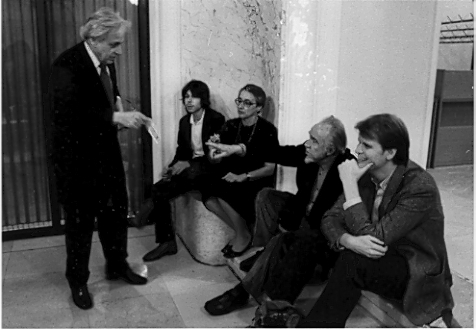
György Ligeti, like Béla Bartók, was born in a town settled by Hungarians in Transylvania, a region that is now a part of Romania. Because he was Jewish, he was sent to a labor camp by the Nazis during World War II. His parents, brother, and other relatives were sent to the Auschwitz concentration camp, where most died (only his mother survived). After the war, he returned to study in Budapest, where Zoltán Kodály (Bartók's fellow folksong gatherer) numbered among his teachers. He graduated from the Franz Liszt Academy of Music in 1949, and like Bartók and Kodály before him, undertook ethnomusicological research in Hungarian music. After a year, he went on to teach harmony, counterpoint, and formal analysis at the conservatory, composing safe, unobtrusive works that would meet the approval of Communist censors. What he really wanted to compose, he kept in his head. "Totalitarian regimes do not like dissonances," he later wrote. He listened in secret to Western radio, trying to stay in touch with new musical developments.
Composer: György Ligeti
-
"Atmosphères"
In 1956, like many of his compatriots, he fled Hungary after the failed uprising against the Soviet Union. He settled with his wife in Vienna and became an Austrian citizen in 1948. In Vienna, he came in contact with the philosophy and musical methods of the electronic music avant-garde through his collaboration with Karlheinz Stockhausen (1928-2007), Mauricio Kagel (1931-2008), and Gottfried Michael Koenig (born in 1926) at the seminal Darmstadt International Summer Courses for New Music.
At the end of the 1970s and the beginning of the 1980s, Ligeti reconsidered all aspects of his composing idiom and entered what might be described as his "post-tonal" period, characterized by an unprejudiced approach to the "Classical" tradition. Among the first results of this reassessment are his three books of Piano Etudes (1985-2001), which show the almost inevitable influence of the etudes of Chopin, Liszt, and Debussy, and of well-established virtuoso keyboard techniques of previous periods.
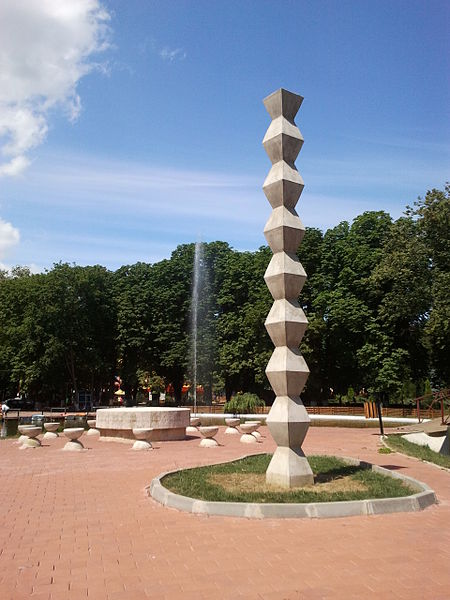
The complex rhythmic polyphony, polyrhythms, and shifting pulses of sub-Saharan African culture inspired Ligeti, as did geometric patterns—he was very interested in geometry and mathematics, especially the fractal geometry of Benoît Mandelbrot and the work of the Romanian sculptor Constantin Brâncuşi. The music of the American composer Conlon Nancarrow (1912-1997) and the pianism of such jazz giants as Thelonious Monk and Bill Evans were also strongly influential. Yet, notice in the two examples below how the music doesn't appear to be a patchwork of styles. Ligeti himself perhaps gave us the clue to this achievement when he wrote the following about the Etudes:
... it is neither "avant-garde" nor "traditional," neither tonal nor atonal. ... These are ... etudes in the pianistic and compositional sense. They proceed from a very simple core idea, and lead from simplicity to great complexity: they behave like growing organisms.
In the fifth etude of Book I, marked "Andante molto rubato, con eleganza, with swing" ("at moderate walking speed, very rubato, with elegance and swing"), Ligeti appears to recall Debussy in the subtle rising and falling in arcs that evoke the rainbow of the title.
Composer: György Ligeti
-
"Études, Book 1: No. 5. Arc-en-ciel"
The seventh etude of Book II shows Ligeti's deep interest in rhythmic complexity and his fascination with Nancarrow's studies for player piano.
Composer: György Ligeti
-
"Etudes Book I: No. 7. Coloana fara sfarsit (Infinite column)"
Ligeti's output continued to be prolific through the 1980s and 1990s. At the turn of the century, his health problems became aggravated, and he died in Vienna at the age of 83.